.
When I reserved our motel in Galveston, the weather forecast predicted weekend would be warm and dry. By the time we left on Saturday morning, things had changed and the forecast was for cool, wet and windy weather. So it turned out not to be the best weekend for birding the coast.
As soon as we arrived on the island, we headed for the Corps Woods, where there had been reports of a Prairie Warbler, a new bird for both of us. We planned to picnic there but it was so cold that we decided to leave after just a few minutes. That's when Dee spotted the Prairie Warbler. It took a while but I finally got a glimpse of it, too, although it was too elusive for a photo.
Less elusive were a Ruby-crowned Kinglet and a Golden-crowned Kinglet.
A Blue-gray Gnatcatcher was even more coooperative.
On our way out of the woods, we ran across our first Catttle Egret of the year.
The ferry ride to Bolivar was as much fun as ever. We spotted several dolphins and there was the usual swarm of Laughing Gulls around the boat.
There were a few stowaways, too.
I was hoping for Red-breasted Mergansers at the Bolivar landing stage and, sure enough, we saw several. I love Mergansers!
The Audubon beach was largely empty of birds, except for lots of Sanderlings, most of which were standing or moving around on one leg, presumably because of the cold.
A Dunlin, too, was using only one leg.
There was the occasional flyby of Brown Pelicans and a couple of small flocks of avocets, and the odd Ruddy Trunstone made an appearance.
The best sighting was of a group of 20+ Long-billed Curlews. There are usually some Curlews on Bolivar beach but we'd never seen so many at once before.
As the beach hadn't been very productive, we decided to take the loop road back to the ferry. It was a good decision.
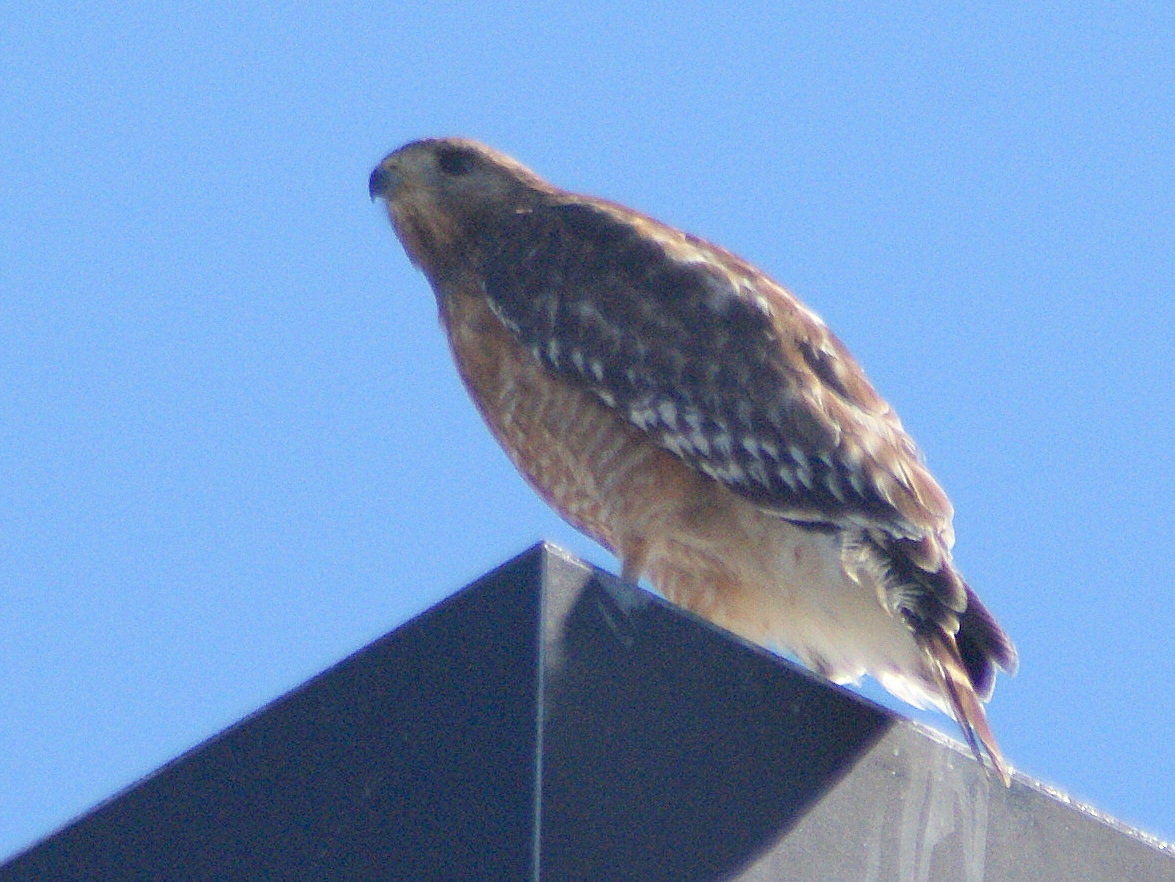
Several of the utility poles were occupied by large hawks. We puzzled over these for ages until we realized they were Red-tailed Hawks.
Further around the loop we stopped to eat our sandwiches in the car. A Belted Kingfisher was perched on the utility wires across the road.
At first we thought that no other birds were present. Then Dee noticed a solitary Roseate Spoonbill in the distance. As I watched it through binoculars, it was joined by a Little Blue Heron. A couple of minutes later, Dee spotted an Osprey perched on a fence post and, before we headed back to the ferry, I saw a White Pelican fly by.
So, although our first day had been comparatively disappointing for birds, we had seen a few interesting species. Unfortunately, the forecast for Sunday was for much worse weather and we supected that it was going to be even less productive for birds. As it turned out, the forecast was accurate but our suspicions were not.
.
.
For the past weeks our yards have been absolutely overrun with American Goldfinch.
They love our niger seed feeders but, when the latter are fully occupied, the Goldfinch seem happy enough to munch on sunflower seeds.
It's amazing how easily they manage to shuck and eat such comparatively huge seeds. Having feeders just outside our windows means that I can watch the process quite closely.
.
.
I own several good bird ID guides but, like many birders, the one I use the most is "The Sibley Guide to Birds". I really only go to one of the other guides if I'm still not sure of a bird's ID after I've looked in Sibley.
I think this situation may be about to change.
I've been reading details of a new guide that's going to be published next month and I suspect that it's going to become my birding bible.
The new book is "The Crossley ID Guide - Eastern Birds" by Richard Crossley.
Crossley's guide is different from all the others because its illustrations emphasize a bird's behavior and how it looks in a variety of common poses. In other words, rather than focusing on the details of a bird's plumage etc., Crossley tries to encourage us to look at each bird's "giss" (general impression of size and shape) and behavior in order to ID it.
The way Crossley has done this is by basing his book on full-page illustrations made up of many different photographs of each species cleverly montaged into a single scene.
The two examples below show how well he has managed to manipulate his photos to produce natural-looking scenes.
American Oystercatcher
Cooper's Hawk
I really can't wait to get my hands on a copy of this book!
.
.
On Tuesday I took a brief walk along the nature trail on the CyFair campus.
Several Northern Mockingbirds perched near the start of the trail seemed to be feeling the cold as much as I was.
The Mockingbirds didn't move as I passed within feet of them. They're certainly not skittish birds. In fact, they're usually very bold. And curious. When I walk the trail, they often fly right down to where I am, presumably to see what I'm up to.
The Great Horned Owl that I've been seeing recently has acted very differently. I usually only get to see its back as it flies off as soon as it hears me approach. This didn't happen on Tuesday, though. I rounded the first bend on the trail and there was the Owl, sitting in the branches and looking straight at me. Perhaps it had gotten used to my appearances along the trail and had decided that I didn't pose a threat. Or perhaps it thought that its camouflage was so good that I couldn't see it. It's hard to know what birds are thinking!
There weren't as any American Robins as on Monday. I counted only about 40 this time. As before, they panicked and flew higher in the trees - or flew away - as I approached.
Maybe they'll get used to me over the coming days. However, I doubt it. I find that Robins tend to be standoffish.
If Robin numbers were down, Cedar Waxwing numbers were up dramatically. I counted at least 100. Most of them were far from the trail but a few were in the trees near what used to be a wetland area. If other years are any guide, I'll soon get much closer looks at the Waxwings. Once they have settled in to the area, they tend to be very tolerant of my presence. I hope this happens, because I love watching and photographing Waxwings. They are such incredibly elegant-looking birds.
.
.
It was cold and dark on the CyFair campus yesterday but there were birds aplenty.
The Great Horned Owl was once again perched at the start of the nature trail - and I once again failed to get a photo. I was a little luckier with a White-throated Sparrow that popped into view for only a couple of seconds.
The trees around the trail were as busy as ever with Yellow-rumped Warblers and about 100 American Robins had also moved into the area. When a few Robins arrived several weeks ago, our resident Northern Mockingbirds constantly harassed them, no doubt hoping to drive them away. Yesterday the Mockingbirds were much less active, presumably overwhelmed by the sheer number of intruders.
Just as I was leaving the nature trail, another flock of about 35 birds arrived. Cedar Waxwings! These usually reach the campus in early December, so they are very late this winter. It will be interesting to see how many turn up. In previous years we have usually had flocks of 200-300 and sometimes of as many as 600.
The lamp standards in the parking lots had their usual complement of Great-tailed Grackles and White-winged Doves but they had been joined by a Ring-billed Gull.
The retention ponds have even more Ring-necked Ducks than they had last week: I counted 120. The ponds also had a pair of Pied-billed Grebes and American Coots, as well as a Belted Kingfisher. A Red-shouldered Hawk was perched nearby, while a Snowy Egret was standing by the side of the waterfall.
The large ditch on the north edge of the campus had a group of six White Ibis, grazing next to a Great Blue Heron. Although I often see Ibis flying over the college, these are the first I have ever seen on the ground there.
.
.
On Saturday morning Dee and I drove up to spend an hour in Spring Creek Park, Tomball.
The north end of the park was virtually empty of birds: After an hour I had seen only a handful of yardbirds, an Eastern Phoebe and a group of 8 American Crows. So we started to leave. On our way out, I drove up the short loop road almost opposite the entrance/exit, because we usually see some birds there.
We had gone only a few yards when we saw a familiar bird fly across the road just in front of us. It was a White-breasted Nuthatch, a bird we've seen scores of times in California and Utah. It landed on a nearby tree trunk and so I got out to take a closer look. I was able to watch it for several seconds. It was in the perfect position for a photo. I raised my camera. Oh, no, I hadn't removed the lens cap. By the time I had taken off the cap, the bird had flown.
I spent the next few minutes exploring the area and saw a good selection of other birds - Cedar Waxwings, Yellow-rumped Warblers, Pine Warblers, Eastern Bluebirds, Lincoln's Sparrow, Chipping Sparrow - but I didn't get another look at the Nuthatch.
On the way home, we stopped off for a few minutes at Theiss Attway Nature Park next to Walmart in Tomball. All we saw there was a Yellow-bellied Sapsucker but the Walmart parking lot had a pair of Red-shouldered Hawks.
This morning (Sunday) our front yard was busy with birds, including 20 White-winged Doves, half-a-dozen House Finches and 40-50 American Goldfinch. I stood at a front window for a while hoping to spot a Pine Siskin among the Goldfinch. And it wasn't long before one turned up!
That's year bird #84 and a new bird for our yard list.
P.S.
Sorry about the quality of the photos. My zoom lens has serious issues and I haven't yet been able to find a replacement.
.
.
Dee and I spent a couple of hours at El Franco Lee Park on the south side of Houston. We arrived a little late for good birding but we still enjoyed walking around the lake and there were some interesting birds.
First up was a male Vermilion Flycatcher - in exactly the same place that I saw him last winter.
This time I saw the female, too. Not as spectacular but still a pretty bird.
The water had hundreds of American Coots and a variety of ducks, as well as a few Great Egrets, Snowy Egrets and Great Blue Herons.
We had to tread carefully along one section of the trail ...
but the rest of it was busy with Yellow-rumped Warblers and Ruby-crowned Kinglets.
My final sighting was a Blue-gray Gnatcatcher; like the Kinglet, the Gnatcatcher is a small bird with lots of personality.
The List
I added to my 2011 list even before we left home, when I looked out of our front windows and saw a House Sparrow on our feeders and a Yellow-bellied Sapsucker on our elm. Then the park added six more new year birds.
Friday was a busy day at work but walking between buildings at the college I startled a Great Horned Owl. As it flew off, it was no more than ten feet above my head. As I was leaving work in the afternoon, a Double-crested Cormorant on one of the retention ponds took my list to 82 species.
.
.
On Sunday I spent a couple of hours birding the Little Cypress Creek Preserve at the junction of Telge and Spring Cypress, just a few hundred yards from our house.
It was busy with birds, including many Yellow-rumped Warblers.
The best sighting was a brief glimpse of an Eastern Towhee, a new life bird for me. Unfortunately, I never managed to get a photo of it.
It was back to work on Monday but there was time for me on both days to look around the campus, where the most exciting event was the arrival of 80 Ring-necked Ducks on the southern retention pond. Later in the week the ducks were joined by an American Redhead, two Lesser Scaup and a pair of American Coots.
Our yards have been busy, too, although no new birds have turned up. American Goldfinches continue to hog the sock and tube feeders so that it's often hard for our Carolina Chickadees and House Finches to find a place to eat.
White-winged Doves have been turning up by the dozen, while the Red-bellied and Downy Woodpeckers and Northern Mockingbird have had to share the suet feeders with an Orange-crowned Warbler, a Pine Warbler, a Yellow-rumped Warbler and a Ruby-crowned Kinglet.
Ruby-crowned Kinglet
Our resident pair of Carolina Wrens were looking for a nesting site yesterday. They checked out a nesting box on our shed but it looked as though the female rejected it. I'm hoping they'll end up choosing to nest in one of our hanging baskets.
Talking of our shed, Dee has had several good looks at the rat family which lives underneath it. The other day she watched as the two adults brought their two offspring out to eat sunflower seeds that had fallen from our feeders.
BTW, by the end of Wednesday my 2011 bird list had reached 72 species.
.
.
The day started well with 13 species in our front yard.
Dee and I had a very pleasant 90-minute drive around Attwater PR National Wildlife Refuge on what turned out to be a clear but windy morning. Perhaps because of the wind, we saw only 21 species, including only two types of sparrow (Savannah and Lincoln's). However, one of the few patches of water on the refuge was busy with several Killdeer, Wilson's Snipes and American Pipits, plus a Sprague's Pipit.
Killdeer
Wilson's Snipe
Eastern Meadowlarks were everywhere.
There were plenty of Northern Harriers and Loggerhead Shrikes.
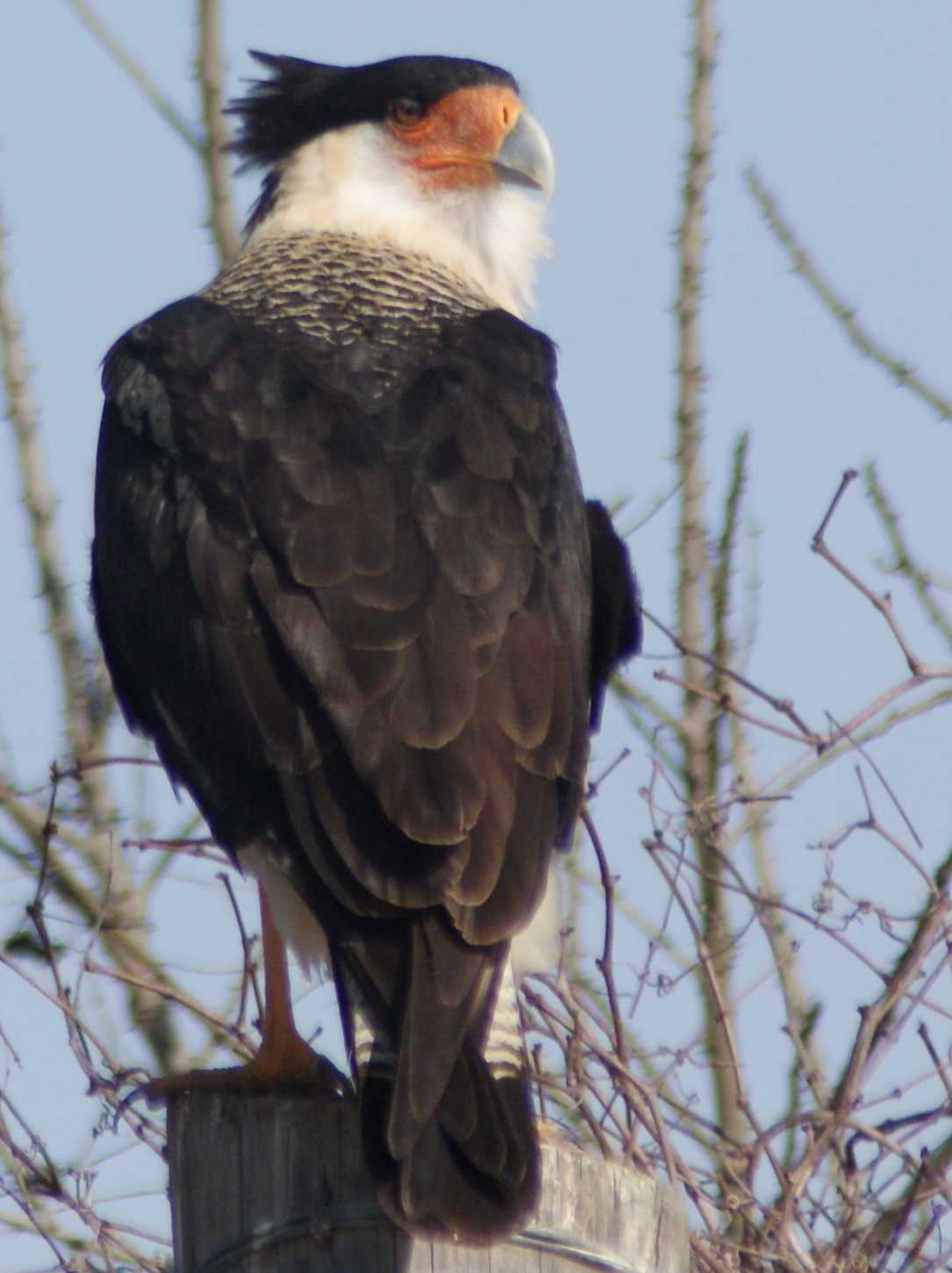
We thought we had missed out on Crested Caracaras but then one appeared just as we were leaving.
We next headed over to Eagle Lake, an area we've visited only once before. Unfortunately, as happened on our previous visit, we couldn't actually find the lake! (Next time, I'll print off a detailed map from the Internet.) However, while exploring the area, we saw several birds, including lots of Red-tailed Hawks, Crested Caracaras and Northern Harriers.
This first day of 2011 produced a list of 42 species.
.
.
In the final few days of 2010, I spent a morning birding Bear Creek Park in Houston.
The park was very busy with birds: I saw 35 species, including my first-of-season Cedar Waxwings and a Merlin.
Most exciting of all was seeing a couple of female Purple Finches, a new bird for my Texas list.
All in all, I did much better with my birding in 2010 than in previous years: My Texas year list was 263 species (vs. 203 in 2009) and my USA year list was 299 (vs. 271 in 2009). My USA/Canada life list moved up from 442 to 456 species.
With regard to Texas counties, I have now passed the 100 species mark in five counties: Harris (225), Galveston (153), Brazoria (134), Chambers (107) and Fort Bend (104).
It's certainly going to be a while before I reach 100 species in any other Texas county. However, the effort to do so will insure that I keep getting out and looking at birds in less familiar areas - which is the only reason for bothering to keep lists.
BTW, my 2011 birding begins later this morning, when Deanne and I are heading over to the Attwater Prairie Chicken NWR.
.