Monday, February 04, 2013

Birding the Bay: Part 1

.
As the weather was good this weekend, we headed down to Texas City on Saturday morning to meet up with some friends and, hopefully, to see Common Loons, shorebirds and some different ducks.

A drive along the dike was rather disappointing, yielding mainly Herring, Ring-billed and Laughing Gulls, some Forster's Terns and a few Sanderlings. 


However, we did see three Common Loons, one of which came close enough for reasonable photos.


The area where the dike joins the mainland had more gulls, along with a couple of Royal Terns. It was odd to see Great-tailed Grackles and Rock Doves/Pigeons wading with gulls.


A Willet was prowling in the shallows.


Willets are very drab birds - until they unfold their wings!


Apart from Willets, the only shorebirds we spotted were half-a-dozen Ruddy Turnstones.


The area also had several Brown Pelicans, a couple of which allowed me to approach within a few feet.


After an hour at the dike we drove the short distance to the Texas City Bay Street Park, where we had a picnic lunch. As I will show in my next post, the park had quite a range of birds even though it didn't add to my year list.
.

Great Yard Birding

.
We spent part of Saturday with friends visiting the Texas City Dike and the San Jacinto State Park area. This trip produced plenty of interesting birds, including some new ones for my year list, and I'll report on it later this week. However, the highlight of the weekend was undoubtedly a Sunday morning visit to a fellow birder's yard in Houston.

Sue Orwig lives near the Edith Moore Nature Center and has created an amazingly beautiful and successful backyard habitat for birds, including several species of hummingbirds. Dee and I visited in February last year and saw our first-ever Buff-bellied Hummingbird. This year Sue was kind enough to let me come over at 8:00 on Sunday morning and then to spend 90 minutes leading me around her yards and showing me no fewer than six species of hummingbirds.

I wasn't able to get sharp photos of the first species we saw - Broad-tailed Hummingbird - but I fared a little better with one of several Rufous Hummingbirds.


I failed again when trying to photograph Calliope, Allen's and Black-chinned Hummingbirds. However, I was more successful with my personal target, Buff-bellied Hummingbird.


Sue's yard didn't only have hummers, of course. Among the many species present were Pine Siskin and Red-breasted Nuthatch. A Wilson's Warbler in the yard was a new 2013 bird for me, as was a Pileated Woodpecker in her neighbor's tree.

P.S.
After the excitement of my visit to Sue's, I spent some comparatively quiet time watching the birds in our own front yard, where the seed and suet feeders nonetheless were bringing in a constant trickle of birds. As usual Carolina Chickadees, Northern Mockingbirds, Orange-crowned Warblers, and Downy Woodpeckers (below) were the most frequent visitors. 


Our winter resident Ruby-crowned Kinglet would slip in whenever other birds were absent. 


Numerous American Goldfinch (below) were accompanied by a couple of Pine Siskins.


Two or three Red-breasted Nuthatches were frequent visitors, too.


I wasn't surprised to see a Brown-headed Nuthatch turn up again, but I was surprised to see no fewer than four of them coming to the feeders and the birdbath.


.


Saturday, February 02, 2013

On the Home Front

.
As last Saturday was warm and sunny, I didn't expect our yards to be very busy with birds. As it turned out, I couldn't have been more wrong!

The day started with flyovers by several skeins of Black-bellied Whistling Ducks, totalling about 150 birds. For weeks now I have seen similar flocks fly north every day before dawn; the flocks fly south over our house every day at dusk. When I returned from Kleb Woods in the late morning, a Red-shouldered Hawk was circling in the distance.

After that I spent most of the afternoon watching our feeders through our living-room windows.

The most numerous species was American Goldfinch, with 30+ individuals visiting.


Orange-crowned Warblers and a Ruby-crowned Kinglet (below) appeared every few minutes to feed on suet.


A couple of Chipping Sparrows (below) and Yellow-rumped Warblers (below) popped in occasionally.


Two of our normal winter residents were missing - Yellow-bellied Sapsucker and Pine Warbler. However, this was more than offset by the continuing presence of three less common winter visitors - several Red-breasted Nuthatches, a Brown-headed Nuthatch, several Pine Siskins (below) and two Rufous Hummingbirds (below).


Most of our year-round residents appeared as well - House Sparrows, Northern Cardinals (below), Carolina Wrens, Carolina Chickadees, a Downy Woodpecker, a Red-bellied Woodpecker, a Northern Mocking bird and a Blue Jay.


The seed feeders in our front yard were attracting a handful of White-winged Doves.


More surprisingly, a couple of Mourning Doves grazed on the grass below the feeders. These are birds that used to visit often but that we now see only rarely.


The biggest surprise of all was an Eastern Phoebe, who perched briefly on our back fence before moving to the birdbath in our front yard.


So we had our biggest one-day total of yardbirds ever: 22 species. In fact, we really had 23 species, because we saw a third hummingbird that wasn't a Rufous but we were unable to ID it.
.

Thursday, January 31, 2013

Where Are They?

.
Early in December every year I start watching out for the arrival of Cedar Waxwings and American Robins. They usually start showing up by the score in our neighborhood and in flocks of hundreds elsewhere in our area. For example, on the CyFair campus we normally see flocks of 100+ Robins and much larger flocks of Cedar Waxwings - often as large as 300-600 birds.

So far, this winter has produced comparatively few sightings of either species, and the sightings that have been reported have generally been of flocks of no more than 20-30 birds. This is no doubt because milder weather further north has meant the birds haven't needed to migrate as far south as usual.

This January I had seen a dozen or so Waxwings on the campus a couple of times before yesterday and only a solitary Robin on one occasion. So I was pleased when I took a quick walk down to the Nature Trail in the afternoon and had a quick glimpse of three Robins.


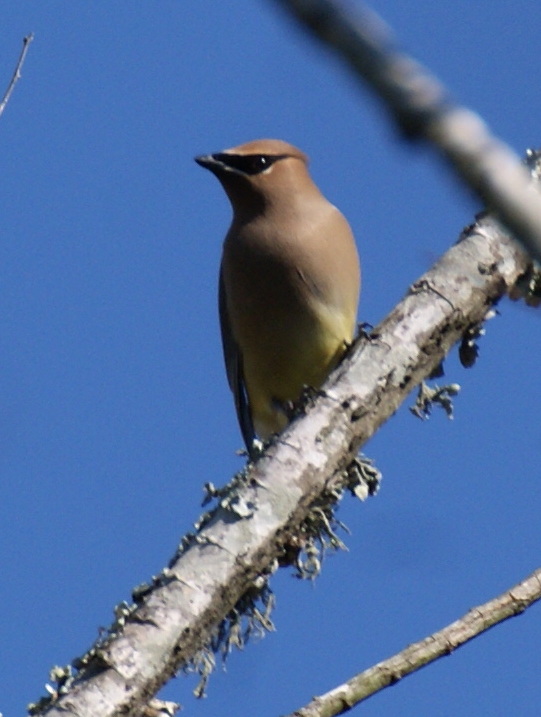
I was even more pleased when a couple of Cedar Waxwings flew in to a nearby tree.


I'm now hoping that the cold front approaching southeast Texas will push more of these beautiful birds into our area.

BTW, I'm sorry the photos aren't better but the birds were at quite a distance and the wind was whipping the trees around. If you want to see better much pictures of Waxwings at the college, just type "Waxwings" into the Search box at the top left of this page and then look at the first two posts that appear.

..
.

Wednesday, January 30, 2013

Red-tailed Hawk

.
On my Monday lunch break I was driving near the college when I noticed a Red-tailed Hawk flying over a field beside the road. I pulled over and took a few photos as the hawk crisscrossed the field in windy conditions.


I expected the bird to move off but instead it started "kiting" - using the wind to allow it to hang almost motionless in one spot. This allowed me to take more photos.


P.S.
This reminded me of a morning many years ago when Dee and I noticed a bunch of of hawks behind our apartment in Pittsburg, CA. We walked over and spent half-an-hour watching absolutely transfixed as 20+ juvenile Red-tailed Hawks kited above a small hillside, swooping down to catch several snakes, which they then passed and repassed to each other. Magical!
.

Monday, January 28, 2013

Kleb Woods

.
Saturday morning I went up to Kleb Woods Nature Center to do some solitary birding - only to find that the Center was hosting a birdwalk for 20+ members of the Houston Audubon Society. As I don't really enjoy birding with lots of people, I spent a short while with the group. During this time I added a Blue-headed Vireo to my year list.

Then I indulged in one of my favorite winter birding activities - I spent 30 minutes siiting by the rosebush at the parking lot entrance and watching birds come to the seed that the Center's staff had scattered under the bush.

House Sparrows, Chipping Sparrows and White-throated Sparrows (below) were the most common visitors.


However, there was also a Lincoln's Sparrow.


Three Field Sparrows joined in.


It wasn't just sparrows that were attracted by the seed. Red-breasted Nuthatch, Northern Cardinals, Carolina Chickadees, American Goldfinch and Tufted Titmice (below) turned up, too.


My final sighting was of a Red-tailed Hawk that swooped low over the parking lot, causing panic among the birds around the rosebush.


Before going home, I drove over to Stone Lake because Canada Geese had been seen there several times this month. Sure enough, as soon as I reached the lake, I spotted 8 Canada Geese resting on the grass.


My day's birding didn't end when I arrived home, because the feeders in our yards were unbelievably busy with birds. But that's a story for another day!
.

Saturday, January 26, 2013

Osprey

.
While we were at Baytown Nature Center on Saturday, we saw several Ospreys. Unfortunately, all were too far away for clear photographs. Then, just as we were leaving, we came across an Osprey perching in a tree and eating a fish that it held down with its talons.


.

Wednesday, January 23, 2013