.
When I got to Baytown Nature Center at 8:00 on Sunday, it was cold enough for me to have to don a jacket. It was also overcast and windy, so clearly not the best weather for seeing and photographing birds. However, the various parts of the site had more birds than I'd seen there for years.
My first stop was by the roadside just after reaching Burnet Bay. The ditch on the landward side had a very cute young Yellow-crowned Night-Heron.
A few yards further along, I was surprised when an adult Great Blue Heron didn't fly off as I stopped beside it but rather stayed and let me take photos from just a few yards away.
Several Laughing Gulls were swirling around overhead and a juvenile came to check me out.
Burnet Bay was empty of birds but the newly-created wetland area on the edge of the bay was absolutely hopping with large waders. This area is so near the road that it makes a perfect place for viewing waders and watching how they interact with each other.
As one would expect there were Great Egrets stalking around in the shallow water, and flying overhead.
Snowy Egrets were even more numerous. Some were hanging out alone or with others of their species.
Several were happily fishing alongside half-a-dozen Roseate Spoonbills.
It's easy to see how Spoonbills get their name.
Of course, when the birds are grazing, their bills aren't visible.
A Tricolored Heron (below) was also moving about near the Spoonbills, while a second Great Blue Heron and an adult White Ibis (below) seemed to prefer to keep to themselves.
After this, I drove to the parking area near the gazebo mound and walked along to Wooster Point. I was hoping that the pools by the trail would produce a selection of migrating shorebirds but this wasn't to be. The only shorebirds that I came across were a couple of Willets (below) and a couple of Black-necked Stilts.
I'm very fond of Black-necked Stilts and have been ever since I saw my first ones, back in the early 1990s on Kauai. So I couldn't resist stopping to take a few photos.
I decided to complete my trip by walking down to the new wetland area next to Scott Bay and by exploring the Heron Haven pond, a part of the Baytown site that I haven't checked out for years. As you will see in my next blog post, this area turned out to be the most productive part of my visit.
.
.
Fall migration may be here but, if so, I'm not seeing too many signs of it.
A few - but only a few - migrants turned up during the Saturday (Sept. 6) bird-walk at Kleb Woods. I missed getting photos of a Yellow Warbler but this Baltimore Oriole stopped to pose.
Three Eastern Wood-Pewees were presumably just passing through.
The best sighting of the day didn't involve migrants but some local residents. All of us were thrilled to see a family of three Pileated Woodpeckers pop up a couple of time during the walk.
The hummingbird feeders were drawing in plenty of birds. All the ones I saw were Ruby-throated Hummingbirds, like this female.
Back at home, our yards have been very quiet: We haven't been putting out much food, plus a Cooper's Hawk is hanging out in nearby trees. Early in the week a male Ruby-throated Hummingbird (below) was defending our one hummer feeder from another male and a female. By the end of the week the males had disappeared and so females were able to feed.
If there weren't many signs of migration at Kleb, there were even fewer on the CyFair campus. The only migrant I spotted all week was a solitary Red-eyed Vireo.
There were quite a few of our normal residents around, though. The utility pylons on the north side of the campus seemed always to have at least one of our Red-tailed Hawks, while a Cooper's Hawk (below) also turned up a few times.
I don't think there was a single day that I arrived on campus without being greeted by a Great Blue Heron and a Great Egret (below) or two.
Yesterday morning I went over to Baytown Nature Center in search of shorebirds. The latter were few and far between but there were plenty of other birds there. I'll post my pictures later this week.
.
.
Rollover Pass on Bolivar can be a great birding site or a poor one, depending on the state of the tide and the number of anglers present there. When we went on the Labor Day weekend, the tide was high and the site was crowded with fishermen. In spite of this, we saw quite a few birds out in the water, along the beach and even in the parking area.
The water had a few large waders (Snowy Egrets and a Tricolored Heron) as well as several groups of Brown Pelicans. The latter species usually fishes by diving into the sea from a height but these birds were adopting a different approach. They would float on the water and then suddenly fly just a few yards before settling back down onto the water and grabbing fish.
Two Marbled Godwits turned up and began to groom as we were watching.
The edge of the beach had adult and young Laughing Gulls.
There were Semipalmated Plovers (with black neck band) and Sanderlings also.
There were some adult and young Wilson's Plovers, distinguished from the Leasts by their heavy bills.
A handsome American Oystercatcher was prowling along the water's edge, while a Willet wandered nearby.
There were Royal and Least Terns, too.
One of the Leasts decided to bathe and groom.
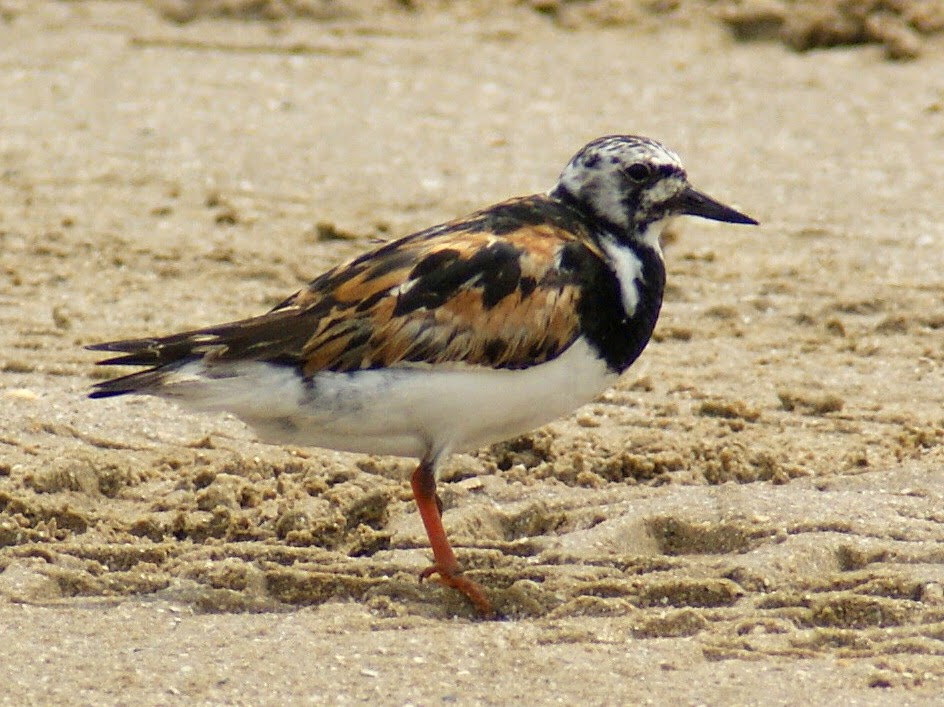
The parking area itself had several of the same birds but also had a couple of Ruddy Turnstones.
The puddles had Snowy Egrets.
As we prepared to leave, I mentioned to Dee that I was disappointed not to have seen a Reddish Egret, a bird missing from my 2014 list. Amazingly, right then one flew down into one of the puddles among the parked vehicles.
It even proceeded to groom just yards from our car.
It was certainly a very good note on which to end our short visit to Rollover.
.
.
Sunday morning we headed for the coast in spite of a weather forecast that promised severe thunderstorms and 80% chance of rain. We were right to ignore the forecast because the only rain we saw were a couple of light showers as we were leaving Houston.
Our destination was Galveston via Bolivar but we decided to make a quick visit to Shovelers' Pond in Anahuac NWR on the way.
One reason for dropping in at Anahuac was in hopes of seeing shorebirds. However, the water level at the pond was so high that there were virtually no shorebirds or waders around. To compensate, there were plenty of Whistling Ducks and Gallinules.
Several adult Black-bellied Whistling Ducks were supervising their offspring.
On this occasion, though, they were greatly outnumbered by their prettier cousins, Fulvous Whistling Ducks.
This duckling stood up to show us that it really didn't have a black belly.
Common Gallinules (formerly Common Moorhens) were even more abundant. Some adults were grazing alone.
Others were accompanying their chicks.
The chicks varied in age and color.
Purple Gallinules were much scarcer than on our previous two visits and they were even more difficult to photograph. This is the only picture I managed to get of an adult.
I was a little luckier with this juvenile, whose plumage was just beginning to turn purple.
As we were completing the auto-loop, I spotted a Neotropic Cormorant that was struggling to deal with a large fish it had just caught.
It was still trying to eat the fish several minutes later when we left on our way down to Bolivar Peninsula.
.