Tuesday, April 19, 2011

Galveston

.
Sunday morning I was up and out before dawn, heading for Sportsman's Road. 

The light was poor but still sufficient for me to enjoy great looks at the large wading birds that fish by the roadside here: Roseate Spoonbills, Great Blue Herons, Little Blue and Tricolored Herons, Great and Snowy Egrets, and White Ibis.


Then it was on to Lafitte's Cove, where I wanted to check out the birding before returning to the motel to pick up Dee.

To my delight, the preserve was almost empty of people but very busy with birds. In the next hour I saw Painted Buntings, Baltimore and Orchard Orioles, Ruby-throated Hummingbird, Blue-winged and Yellow-rumped Warblers, Prothonatory Warbler, Blue-headed and Red-eyed Vireos, Rose-breasted Grosbeaks and Northern Parulas.

  Rose-breasted Grosbeak

Indigo Buntings and Black-throated Green Warblers were as plentiful as they had been at High Island.


I was particularly pleased to see my first Great Crested Flycatcher of the year. 


When I returned to the site with Dee at 9:30, I was disappointed to see that it had turned windy, which was keeping many of the birds out of sight. I was disappointed, too, to see that the drips were being largely monopolized by a few photographers using tripods, to the exclusion of most of the dozens of other visitors who would have liked to watched the birds that were drinking and bathing.

However, we did squeeze in at one drop for a few minutes and watched Hooded and Black-and-White Warblers come to drink and bathe. 


The highlight for me was getting very close views of several Northern Parulas, a bird I rarely get good looks at.


We then wandered around for a while, stopping to admire the wildflowers as well as the migrant birds.

On our way out, we paused for a few minutes at the edge of the wetland area across from the preserve's main entrance. The water here had several Mottled Ducks and Blue-winged Teal.


There were plenty of shorebirds, too, including Black-necked Stilts, Killdeer, a Solitary Sandpiper, Long-billed Dowitchers, and Lesser Yellowlegs.


Black-necked Stilt
Solitary Sandpiper
Long-billed Dowitcher
After this it was time to start back towards home, stopping along the way for a coffee break at Offat's Bayou, where we enjoyed watching a Forster's Tern diving for fish and  nice views of a Willet and a Ruddy Turnstone.

P.S.
Although we birded for less than 8 of our 25 hours at the coast,  we saw about 90 species. I saw only one lifer (Blue-winged Warbler) but added 25 species to my year list, taking the latter to 228.
.

Monday, April 18, 2011

Back to High Island

.
When we got back to Boy Scout Woods, we found that migrants had indeed arrived en masse and there seemed to be birds everywhere. Since the benches at the drip were even more crowded with birders than before, we spent the next two hours walking the paths, stopping whenever we saw bird activity.

Indigo Buntings were abundant, with some males in full indigo plumage and others still showing mottling on their breasts.


Rose-breasted Grosbeaks, Summer Tanagers and Scarlet Tanagers added touches of red to the scene.
 Scarlet Tanager
So, too, did Painted Buntings, although they tended to stay in the shade, which hid their other colors.

Baltimore and Orchard Orioles added yellow or orange, depending on whether the birds were female or male.
 Orchard Oriole
Less colorful but no less plentiful or active were Blue-headed and Red-eyed Vireos and Eastern Kingbirds.


Red-eyed Vireo
Eastern Kingbird

Warblers

But, of course, the main reason people go to High Island is to see warblers.

Our first warbler sighting of the afternoon came when we bumped into Nick and Scott (our shorebird guides), who pointed out a Swainson's Warbler.

We then spent a lot of time watching several Blackburnian Warblers, to my mind the most beautiful of all warblers - and it seems always one of the most difficult to photograph!


After straining our necks to watch the Blackburnians and a couple of Black-and-whites, we were relieved to run into a group of Black-throated Green Warblers that stayed mainly at eye-level.


It's easy to see how the Black-throated Green Warbler gets its name.


On to Galveston

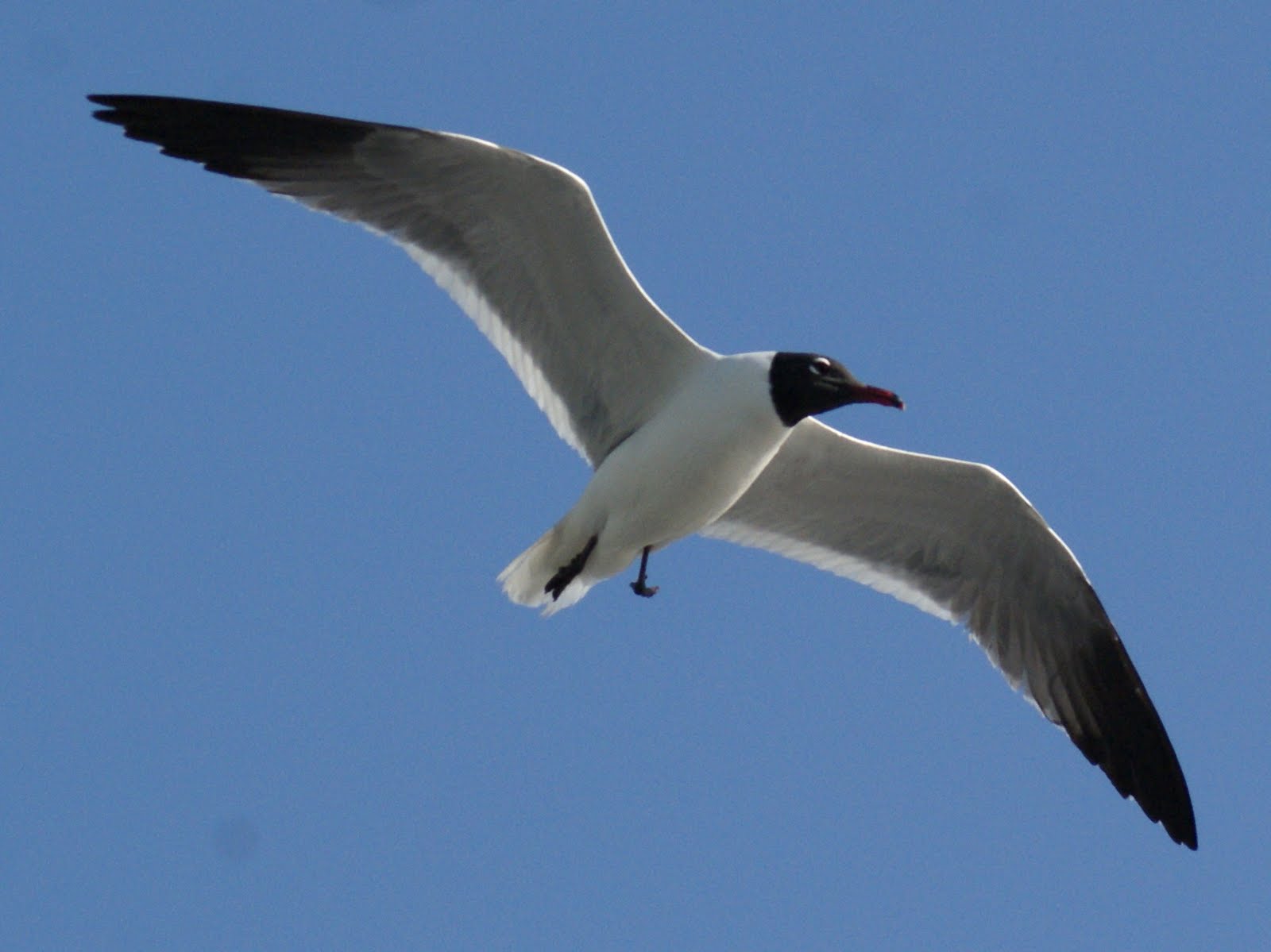
By 4:30 we were both feeling birded out and so we decided to head to our motel on Galveston. We stopped along the way at the Barn Owl box on Retillon Road but didn't manage to see the owl. At the Bolivar ferry landing we also struck out when we looked for the Long-tailed Duck (formerly Oldsquaw) that has been hanging out there. So we had to make do at the landing and on the ferry ride with the usual Laughing Gulls and Double-crested Cormorants.


So, it had been an excellent birding day and we still had Saturday morning at Lafitte's Cove to look forward to before we would have to head home.
.

Sunday, April 17, 2011

High Island & Bolivar

.
We arrived at Boy Scout Woods at 10:30 on Friday to find the site absolutely hopping with activity. Unfortunately, there were a lot more human visitors than avian ones! 

We stayed for 90 minutes and were rewarded by views of some good birds - Indigo and Painted Buntings, Kentucky Warbler, Black-throated Green Warblers, Yellow Warbler, Summer Tanagers, Eastern Towhee, Northern Waterthrush, Eastern Kingbirds, Baltimore Oriole and a dozen or more Orchard Orioles. However, most of the birds were at the drip, where the benches and the surrounding area were jam-packed with birders. So, feeling rather claustrophobic, we decided to join in the shorebird trip led by Scott and Nick from Tropical Birding. If, as I hoped, the anticipated cold front arrived in the early afternoon, we could return to High Island later in the day to see whether more birds had turned up.

The shorebird trip was excellent, partly because there were plenty of birds to see and partly because our two guides were extremely friendly and knowledgeable. (Many thanks, Scott and Nick!)

The first stop was at Rollover Pass, where the beach and sandbars were crowded with hundreds of birds. Among the closest birds were scores of Black Skimmers, among our favorite birds.

 
Many of the Skimmers were hunkered right down on the sand, a typical behavior of these remarkable birds.  


Terns were plentiful, too. With our guides' help, we were able to pick out Royal, Caspian, Black, Forster's, Common and Least.

 Royal Tern
Forster's Tern
Further away, sandbars and the shallow waters were busy with Black-necked Stilts, American Avocets; Willets, American Oystercatchers, Marbled Godwits, Sanderlings, Great and Snowy Egrets and several other species, while Brown Pelicans constantly flew overhead.


The next stop was along Bob Road, where a Seaside Sparrow noisily greeted our arrival. The wetland area had Roseate Spoonbills, Great and Snowy Egrets, Blue-winged Teal, Common and Black Terns, and a good selection of shorebirds.


The shorebirds included: Least and Semi-palmated Sandpipers; Greater and Lesser Yellowlegs; Whimbrels; Willets; Black-necked Stilts; Dunlins; Wilson's, Black-bellied and Semi-palmated Plovers; Short-billed Dowitchers and a Wilson's Phalarope.

 Wilson's Phalarope
 Willet

The tour was scheduled to proceed to the Audubon beach but our guides announced that migrants were arriving in large numbers at Boy Scout Woods. So we took at last look at the shorebirds and then all piled into our cars to rush back to High Island. As I will explain tomorrow, the rush was worthwhile!
.     

Saturday, April 16, 2011

The Week at CyFair

.
I haven't had much time for birding CyFair this week, and what I have seen on walks around the campus has varied greatly from day to day.

Tuesday was the quietest day I can remember there for birds. My total sightings were two Northern Cardinals, a Northern Mockingbird and half-a-dozen Purple Martins. I didn't hear much either, except for Eastern Meadowlarks and Red-winged Blackbirds. The many White-eyed Vireos that had arrived last week seemed all to have disappeared.

Wednesday and Thursday were better. Several White-eyed Vireos were back and they were joined by at least one Gray Catbird and a Ruby-throated Hummingbird.

 White-eyed Vireo

I don't know which is louder, the constant chattering of the Vireos or the does-anyone-want-to-mate-with-me calls of the male Northern Mockingbirds.


Definitely not as noisy but much more melodious is the call of the male Red-winged Blackbirds. This one called for ages from a tree right by the college cafeteria but kept trying to hide from my camera.

 
Most of our normal birds were easy to see and/or hear: Great Egret, Purple Martins, Mourning Doves, Northern Mockingbirds, Northern Cardinals, Brown-headed Cowbirds, Red-winged Blackbirds and Eastern Meadowlarks.

A few new-for-2011 birds have turned up. A Chimney Swift flew over on Wednesday and a Swainson's Thrush on Thursday. Also on Thursday I noticed a Green Heron fishing on the waterfall above the retention ponds. So my year list is now 203.

The nature trail is festooned with blossoms - mainly honeysuckle but also some plants I don't know.


Away Again


By the time you read this, Dee and I will be away on a mini-trip. We're going to visit High Island and Bolivar on Friday, hoping for lots of migrants as well as for good nesting activity in the High Island rookery. We'll spend the night on Galveston and then try for migrants again, this time at Lafitte's Cove. Wish us luck!

.