.
Family obligations have still made it impossible for me to get out and do some birding and wildlife watching. Luckily, our yards have continued to be fairly busy.
Gulf Fritillaries have been visiting daily to lay their eggs on our passion fruit plant.
Monarch butterflies pop in occasionally, although their caterpillars appear to have disappeared from our milkweeds.
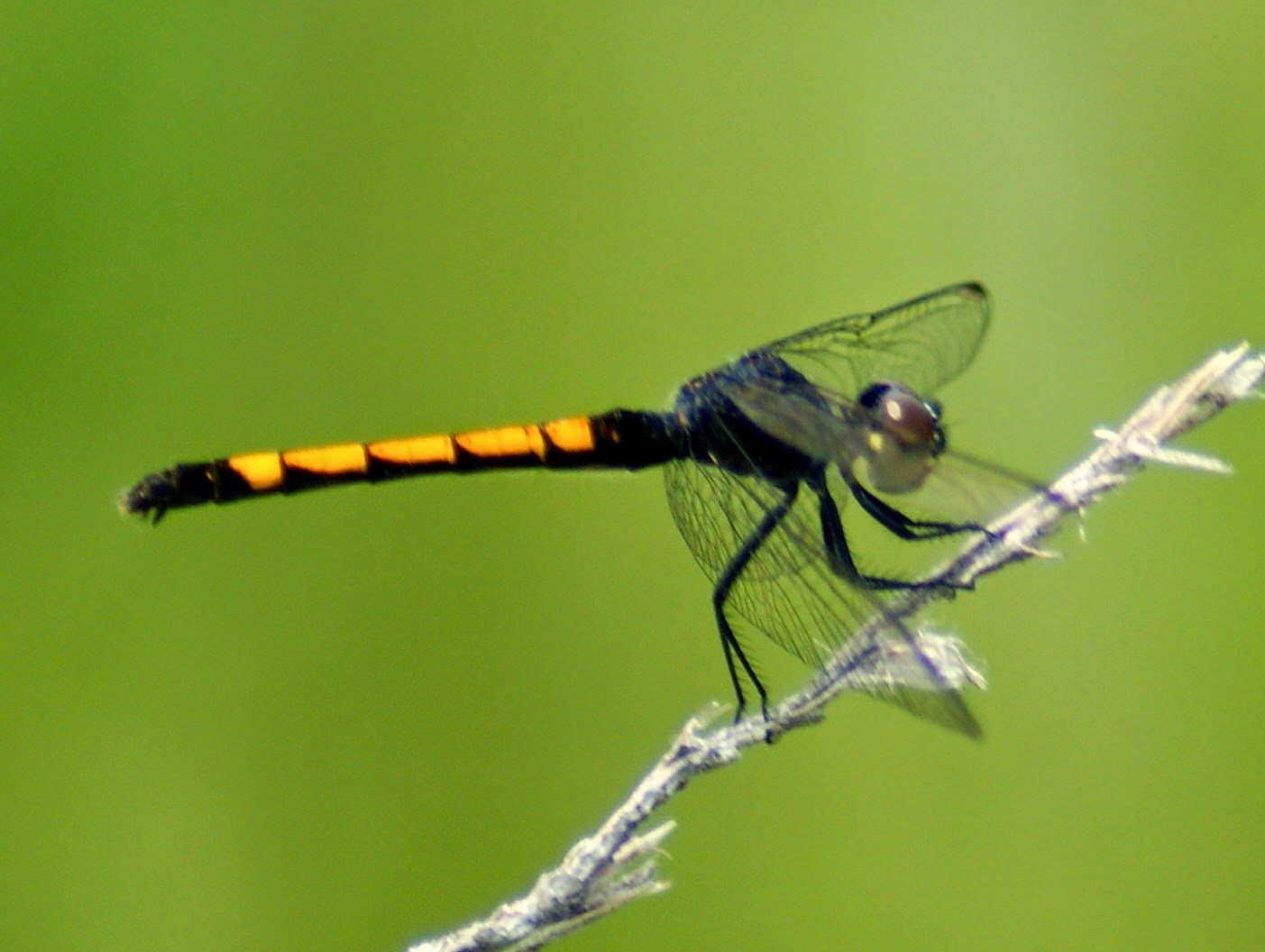
Several different dragonfly species turn up every day.
As usual, there are anoles everywhere. However, this year we seem to have almost as many mediterranean geckos.
All of our resident birds are around every day. We're always pleased to see our Northern Cardinals, Carolina Chickadees, Carolina Wrens, Downy Woodpeckers, Red-bellied Woodpeckers, Blue Jays and Tufted Titmice (below).
We're much less pleased to see hordes of White-winged Doves and House Sparrows arrive whenever we put birdseed on our back fence. Still, we can't help but like this one young House Sparrow who spends ages sitting on the fence and trying to beg food from all the other birds that come by, irrespective of their species.
For weeks we've seen only the occasional House Finche but yesterday we were glad to spot a male and a couple of females at the feeders.
Male Ruby-throated Hummingbirds arrived about ten days ago. Now that fall is fast approaching, it shouldn't be long before lots of females drop in on their way down to Mexico.
.
.
Once again last week, work and other things continued to keep me from doing any serious birding. The best I could manage was an hour at Paul Rushing Chain of Lakes Park on Sunday morning.
I was hoping to see a Horned Lark, plus the Least Bittern that Sarah and Mike Kuzio spotted there a couple of weeks back but I didn't see either. When I arrived, three Common Nighthawks were circling well beyond camera range while a Turkey Vulture (below) was flying much lower.
There were the usual large wading birds, including a couple of Great Egrets.
I quietly approached a Snowy Egret that was standing on the handrail of a boardwalk. When I got nearer, its greenish legs revealed it to be an immature Little Blue Heron.
Adult Black-necked Stilts were kicking up a ruckus in the weeds and reeds.
When I looked more carefully, I realized that they were accompanied by several juveniles.
The water was empty of birds except for a solitary American Coot and one Pied-billed Grebe.
Back in the parking lot, I stopped to grab photos of a few Killdeer that were hanging out there.
My impression of the visit was that I had seen hardly any birds. However, when I drew up my visit list, I realized that I had actually seen quite a few:
Black-bellied Whistling Duck 2
American Coot 1
Pied-billed Grebe 1
Great Blue Heron 1
Little Blue Heron 1
Yellow-crowned Night-Heron 1
Great Egret 3
Snowy Egret 2
White Ibis 1
Killdeer 30
Black-necked Stilt 10
Forster's Tern 1
Common Nighthawk 3
Turkey Vulture 1
Black Vulture 1
Rock Pigeon 10
Eurasian Collared Dove 1
Barn Swallow 3
Cave Swallow 6
Purple Martin 25
Mourning Dove 20
Loggerhead Shrike 1
Northern Mockingbird 3
European Starling 20
Red-winged Blackbird 15
Great-tailed Grackle 20
.
.
Late Saturday morning we spent an hour in the park around the San Jacinto Monument.
To be honest, the park isn't one of my favorite birding sites: Although it can host some good birds, the latter are usually too far away for comfortable viewing and photographing. So why did we visit? We were on our way to have lunch at the nearby Monument Inn, and I thought the park might have one of the bird species that has eluded me so far this year: Black-crowned Night-Heron.
We started our visit with a quick walk along the boardwalk, which yielded only very distant views of a few common wading birds, such as Great Egret and Great Blue Heron.
When we drove to the two areas that give views over the bay, we had better luck, although most of the birds were still so distant that photographing them was a challenge.
Several Cattle Egrets in breeding plumage were wandering about on the grass.
A couple of American White Pelicans were cruising the waters while others had settled on islands.
One of two Brown Pelicans was much closer to the shore.
I was delighted to spot two Black-crowned Night-Herons as they flew off when I approached the water. Although I didn't manage to get a photo of them, I did manage to get some shots of seven Wood Storks perched in nearby trees. What extraordinary looking birds they are!
A Tricolored Heron was too intent on fishing to notice our presence.
The size of the prey it caught hardly seemed to justify the effort involved.
A Great Egret was rather more successful.
Further out, Neotropic Cormorants were lined up. These ones were in the company of a Snowy Egret.
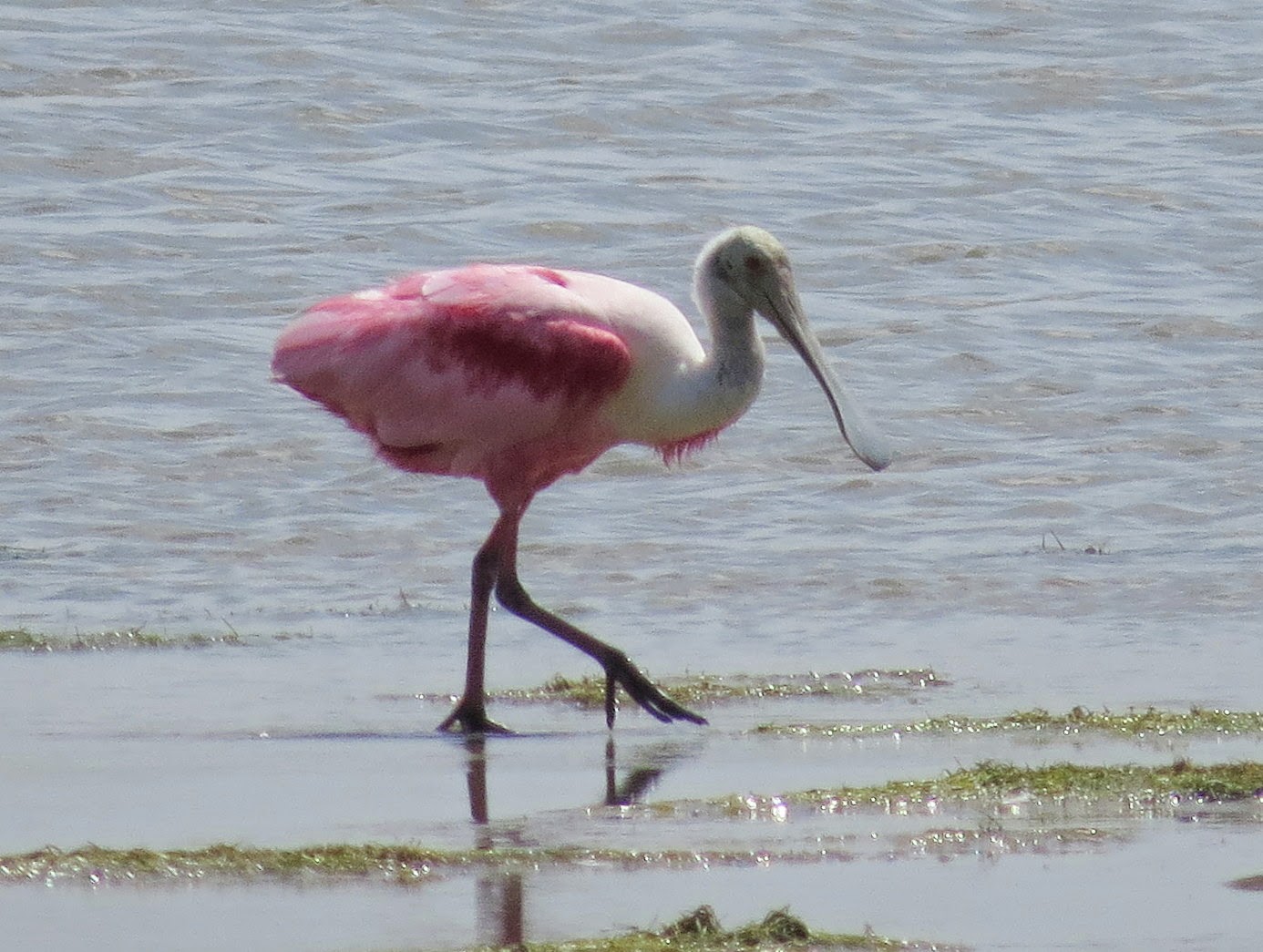
A handful of Roseate Spoonbills were grazing in the water.
Other birds, such as a Brown Pelican and a Great Blue Heron, were perched on rocks or pieces of debris that protruded from the water.
So while the park didn't provide great birding, we saw enough to make an hour's visit worthwhile.
.
.
For the past few weeks it has been fun watching a steady stream of Blue Jays coming to our backyard.
They are mainly attracted by the peanuts that we put out on our fence.
While some of these visitors are adults, many of them are juveniles. Very young birds are normally easy to pick out because they don't yet have a full crest and they lack the heavy black band across the top of their chests.
Older juveniles look a little more like adults but their age is given away by the yellow/pink edges of their beaks.
.
.
Between our two loops around Shoveler Pond at Anahuac on Saturday, we drove down to Frozen Point, stopping along the way to check out the roadside ditches and fences.
On our last visit to the refuge we hadn't seen any Common Nighthawks. This time we saw seven. As usual, most were sitting quietly on fence posts.
However, a few were being a little more active.
One was even sitting up, revealing its barred underside.
Halfway down the road, we came upon two King Rails. Although one immediately disappeared, the other crept through the grass on the verge for a couple of minutes while we drove slowly along beside it.
We stopped for a quick picnic lunch at Frozen Point, where we were surrounded by thousands of golden-bodied dragonflies. Neither of us had ever seen so many dragonflies in one place before.
The shoreline was empty of birds except for a solitary Willet.
Willets are very drab birds - until they fly!
I was hoping for Seaside Sparrows and, sure enough, one appeared right where the road is blocked by a gate.
Two other Seaside Sparrows were pottering around in the rocks nearby and then we saw four more as we started our drive back to the Visitor Center. One of them treated us to a beautiful serenade that seemed to last for ages but was probably only 2-3 minutes long.
A few yards up the road we were serenaded by a different bid, this time a Dickcissel. Unfortunately, I wasn't able to get a photo before it flew off. (We had seen several other Dickcissels on the entrance road to the refuge but I hadn't managed to get photos of any of them either.)
At the place where we had seen the King Rails, we stopped again when Dee spotted a bird in a bush. It was our only Least Bittern of the day.
The same area had an adult male Black-necked Stilt.
Further away from the road, another adult Black-necked Stilt was wading in very shallow water. Judging by the brown on this bird's back, it was a female. It was accompanied by what I at first took to be a small shorebird. However, when I looked carefully through binoculars, I realized the small bird was actually a baby Black-necked Stilt.
It was a nice sighting with which to end what had been a very productive and enjoyable visit to our favorite local wildlife site.
.