.
I haven't added any new birds to my year list recently, mainly because few new species appear in our area in the summer. But this is a great time of the year for birdwatching, because most of our permanent and summer residents are breeding.On the CyFair campus, I spent part of yesterday morning looking for the Western Kingbird family that disappeared from their nest over the weekend. First I had to find out where the adults were flycatching.
 Then I had to follow them as they flew off to take their prey to the young Kingbirds. As I can't fly over buildings, this took a while! However, I eventually tracked down the three youngsters, who are together in a small pine tree well away from the nest site. Appropriately enough, their new "home" is right next to the college day-care center.
 The youngsters look fit and healthy ...
 and very cute.

 Back at home, more and more young birds are appearing at or around our feeders.Yesterday morning a young male Northern Cardinal we've been seeing for weeks turned up with another, even younger male.
 Another young Blue Jay appeared, too.
 It sat on the fence and begged for food until the parents came and shepherded it away to a less exposed location.
 .
.
.
 .
.
.
When I reached the Western Kingbird nest on the CyFair campus yesterday morning, it was empty. So the parents must have moved the chicks out over the weekend.
In previous years, the chicks moved down to small pine trees near the nest site and they stayed in these trees for several days, being fed and watched over by the parents.
Yesterday I carefully checked all the trees but couldn't see any birds. Then just as I was leaving, an adult Kingbird flew overhead and there was a burst of squawking from the top of one of the pines. I walked over and the noise immediately stopped. I examined every inch of the tree and could just make out part of a tail among the branches. I waited for 10 minutes but there was no movement and no more squawking. It seems that, young as they are, the chicks know to keep very still and quiet whenever a possible predator approaches. Good for them!.
.On a recent visit to Playa del Carmen in Mexico, I was lucky enough to see many different types of large moths.
Around our house in Cypress, we get to see a lot of moths but most of them are very small. So I was pleased when a large, interestingly-patterned moth flew into our living-room yesterday.
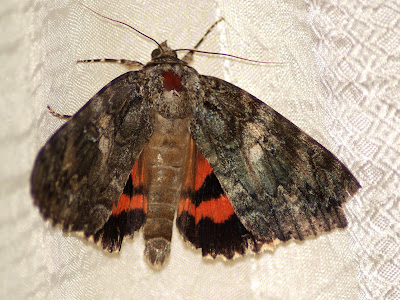 I know nothing about moths (and little more about butterflies). However, I posted a photo on BirdForum and a kind contributor informed me it is a Dark Crimson Underwing. I'll take his word for it!..
.On Thursday I was disappointed when I thought that the Red-shouldered Hawk chicks had flown from their nest on Louetta. However, when I checked on Friday, I was delighted to see that both chicks are still in the nest.
 While I was there, an adult arrived with food ...
 and quickly flew off again, leaving the chicks to feed themselves.
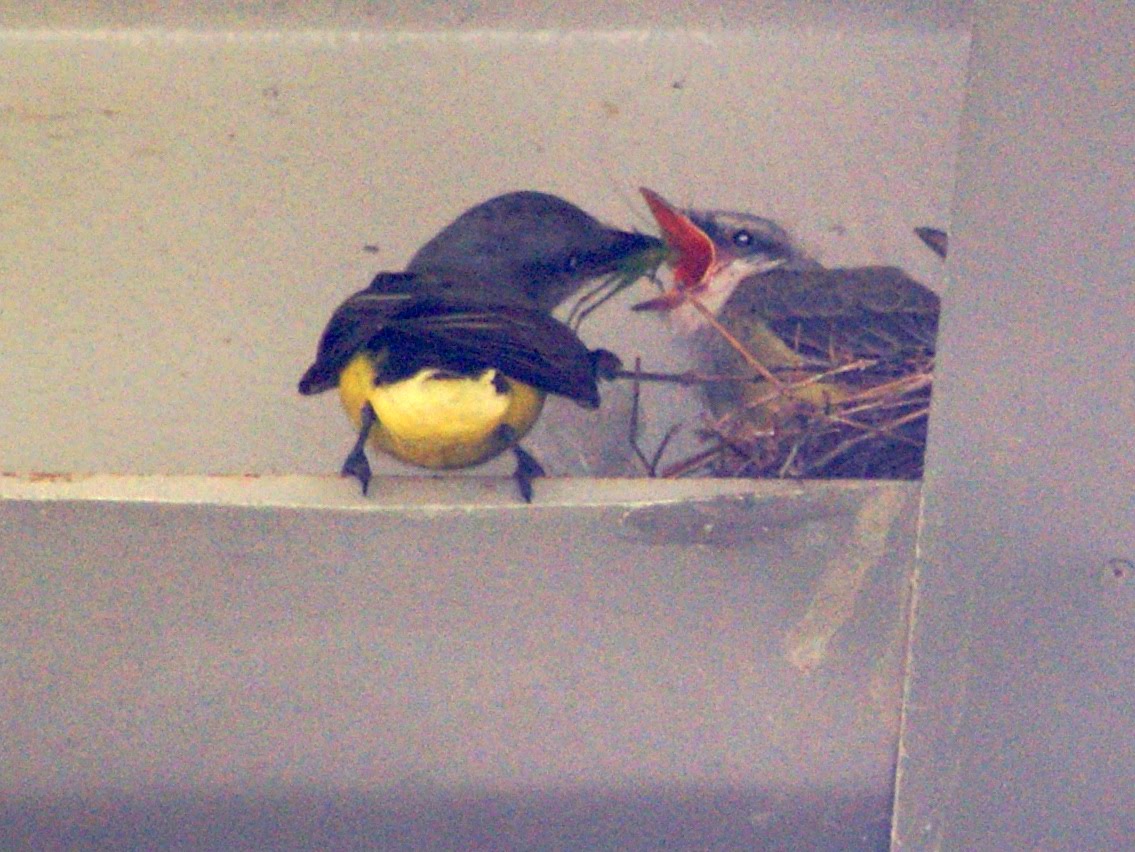
 Earlier on Friday I spent half-an-hour watching the Western Kingbird nest on the LSC-CyFair campus. As far as I could see, there are only two chicks in the nest. (Last year this pair of Kingbirds raised four young. I wonder if they will raise fewer this year because construction work on the campus has reduced the number of insects available to the birds.)
 Two chicks are just visible
The parents were busy bringing bugs to the nest every 2-3 minutes. In between times, the adults would perch on nearby trees or on the floodlights around the adjacent tennis courts.

I noticed that the parents are accompanied by a third Kingbird, presumably one of the young they raised last year. Unfortunately, I couldn't tell whether the third bird was helping out with feeding this year's chicks or was just providing moral support.
Sometimes both parents would arrive with food at the same time, so one had to wait perched above the nest until the other had fed the chicks and flown off.


Some days ago I mentioned that the adults were carrying eggshell fragments out of the nest. On Friday I realized that this was not the case. What they were really doing was carrying away fecal sacs: the chicks' droppings. I had forgotten that many small birds keep their nests clean by collecting their chicks' poop and carrying it away from the nest.
 Kingbird carrying away a fecal sac
 Red-shouldered Hawk chick pooping over the side of its nest
.
It has been a while since I posted about what's happening in our yards. This isn't because the yards have been quiet. On the contrary, they have been very busy - so busy that we are going through huge quantities of birdseed.
Our most frequent and numerous visitors are White-winged Doves. We often have 20 or more, of which several are clearly juveniles. (Note the tuft of white feathers under the eye.)
 The Doves spend a lot of time trying to access the tube feeders. They can perch on the feeders but can't manage to eat from them. So then they settle for eating the seed that has fallen onto the ground from the feeders.
The next most numerous visitors are House Finches. Our normal number of 7-8 has roughly doubled with the arrival of this season's chicks. They come to our tube feeders at dawn and stay till dusk, moving away only when bigger birds fly in.
We haven't spotted any young Carolina Chickadees or Caroline Wrens yet but adults of both species come to our feeders a lot. The young are presumably safe somewhere nearby.

We have several adult and young Blue Jays, both of which eat mainly from the tube feeders. The adults, though, get particularly excited whenever we put out peanuts in their shells.

At this time of year we usually get visits from Northern Cardinal youngsters accompanied by their parents. This year we have only noticed one young Cardinal and he seems to be parentless: He visits alone and our adult Cardinals show no interest in him. He has spent a lot of time sitting on our feeders but hasn't yet worked out how to access the seed in them. So he has to join the White-winged Doves in eating the spilled seed on the ground.

Our suet feeders have been busy with adult and young Northern Mockingbirds. A Young Downy visits them, too, but has to move aside when a young Red-bellied Woodpecker comes to feed.

 We have also had visits from a few birds that we rarely see in our yards. Common Grackles have appeared a couple of times, and a young House Sparrow turned up once to check out our tube feeders. Then yesterday the first American Robin that we've seen for ages decided to check out the flower beds in our front yard.

It's wonderful to see so much activity at home, even if it has meant that we have to replenish the feeders more or less daily.
Squirrels
Our squirrels have been busy, too. We finally got to see a baby last week when an adult carried one in its mouth along our fence. Very cute!
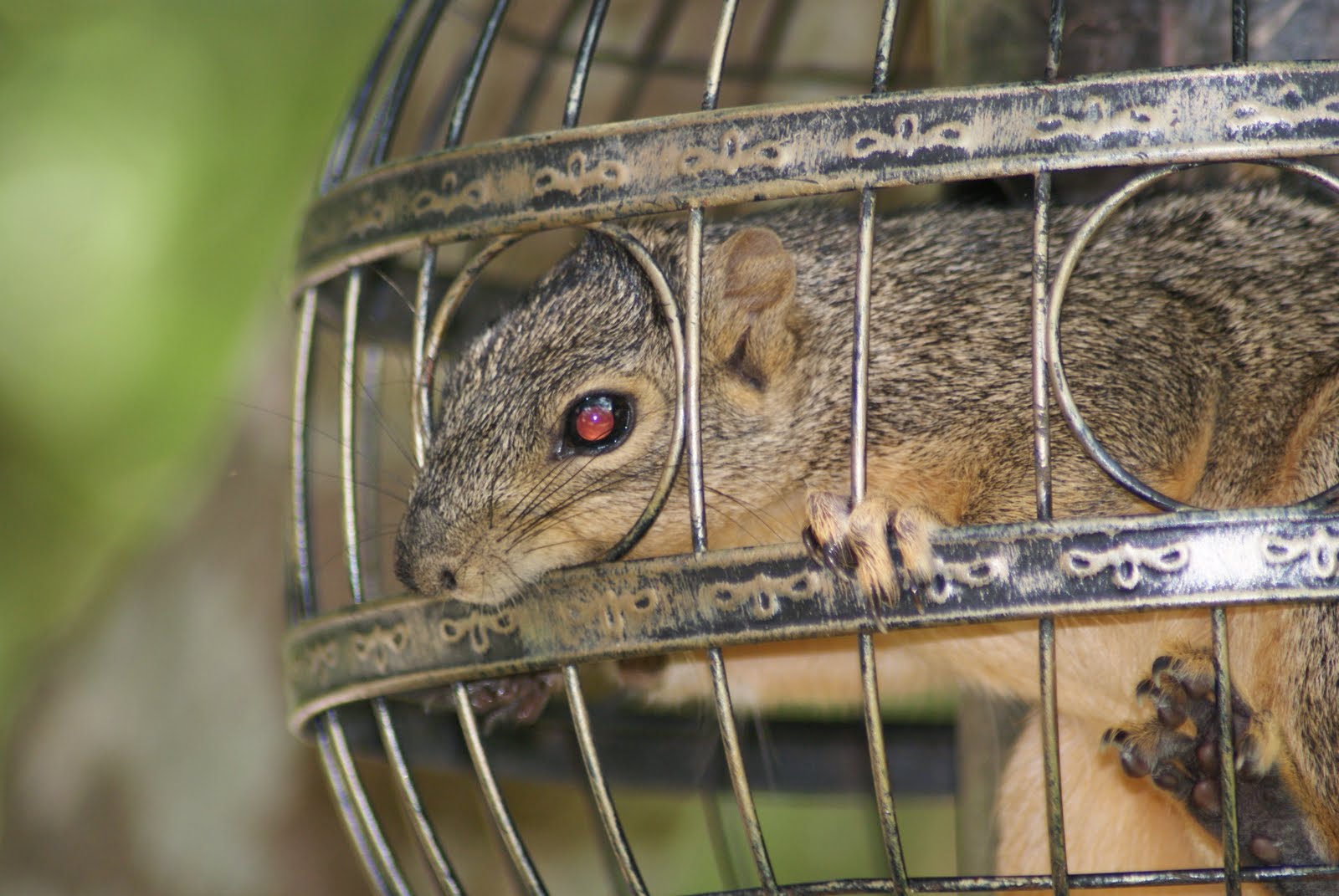
Less cute is the fact that one squirrel has learned to get into a "squirrel-proof" cage feeder. It sits in there for hours munching through the sunflower seeds.
 .
.
.Yesterday I finally managed to get back to the Red-shouldered Hawks' nest on Louetta. Unfortunately (for me), it was empty. So the two chicks fledged and moved out while I was out of action. I'm sorry to have missed seeing them as they left but no doubt they are now safe and well somewhere in the area, so perhaps I'll see them again.
It was some consolation to see action at the Western Kingbirds' nest on the CyFair campus, although the position of the nest made it hard to see exactly what was going on. In the morning I spotted one adult apparently feeding one almost invisible chick before leaving the nest with a chunk of eggshell in its beak.
Later in the day I arrived to see one adult sitting in the nest and the other perched a few inches above it. As I watched, the first adult flew off the nest and the other hopped down onto it.

The adult that left spent a few minutes preening on a nearby fence.
 When it returned to the nest, it displaced the other adult, which flew up to perch on the roof of the basketball court.

So it's clear that the adults are sharing parenting duties. Now I'm looking forward to seeing how many chicks they raise. Last year they successfully raised four. However, all the construction work on the campus has significantly reduced the amount of hunting habitat available to the birds. If this has reduced the number of insects available as prey, the Kingbirds may raise fewer young this time around.The BP Oil Disaster
Last night CNN showed heartbreaking images of gulls and pelicans covered in oil along Louisiana's coast and we are no doubt going to see many more such images over the coming weeks and months. However, what we see will only be a small part of the real effect of the oil on the bird population. Most of the affected sea birds will suffer and die out on the Gulf far away from the media's cameras. Meanwhile large numbers of rails, Least Bitterns and wading birds must already be dead or dying unseen in the sections of marshland that the oil has reached.
Like most people, I am outraged by BP's conduct. However, BP isn't the only guilty party. At the local level, Louisiana's politicians are guilty of having allowed and encouraged oil companies and developers to erode the state's wetlands over the past decades. At the national level, politicians of both parties are guilty of accepting campaign contributions in return for not regulating drilling operations as strictly as such operations are regulated in Europe. (This is just one small part of Ronald Reagan's legacy!) At the national level, too, we are all guilty for having developed such a voracious appetite for oil and turning a blind eye to the inevitable consequences of our obscene level of energy consumption.
It would be consoling to think that the current disaster will change attitudes about energy consumption and lead to meaningful restrictions on drilling. However, it won't. Congress will no doubt pass some new laws but, as usual, our politicians will cooperate with lobbyists to fill these laws with loopholes that insure corporations can go on despoiling the environment at will. And we, the media and the politicians will be filled with self-righteous outrage when the next disaster strikes. .


 and very cute.


 .
.