.
We still have a male Rufous Hummingbird in our yard. Unfortunately, the miserable weather and low light make it impossible for me to get really sharp photos!
.
Jeff Mohamed blogs about birds and other wildlife in the Houston area - and occasionally farther afield.
Wednesday, January 16, 2013
Monday, January 14, 2013
Cold and Windy Birding
.
Yesterday morning I dragged Dee out to do a couple of hours birding in cold and windy weather, mainly because I wanted to add some more species to my 2013 list for Harris County.Our first stop was at Sheldon Lake, where we almost immediately saw an American Bittern flying from side to side of the first fishing pond. Other new birds that we turned up on our walk around the Environmental Center area were Anhinga, Double-crested Cormorant, Laughing Gull and Snow Geese (below).
We decided to move on to Baytown Nature Center as several interesting birds had been reported from there during the past few days.
The wind was blowing hard as we drove towards the fishing pier at the end of the road. On the way we passed several Brown Pelicans, a Belted Kingfisher, a Mallard and a Snowy Egret.
The water was rough on the bay and all that I could see from the pier were a couple of hundred Lesser Scaup and a score or so Ruddy Ducks, all too far away to photograph.
We drove back and parked near the hummingbird garden, from where we watched an Osprey kiting as it fished the choppy waters.
Other birders had spotted Eared and Horned Grebes but the only grebes we saw were two Pied-billed Grebes. However, they were accompanied by a Common Goldeneye (below), another new bird for 2013.
As neither of us likes cold weather, we left Bayiown after only 30 minutes and headed home. It hadn't been the most pleasant or productive of outings but we had seen a few good birds and I had boosted my year list from 82 to 93 species.
.
Saturday, January 12, 2013
Lately at CyFair: Part 2
.
The Nature Trail has been quiet so far this year except, of course, for Northern Mockingbirds.A few Yellow-rumped Warblers have turned up here, as well as at other places around the campus.
A couple of Pine Warblers sometimes tag along with the Yellow-rumped.
There were several sparrow species on the campus in December. Now we seem to have only Savannah Sparrows.
A solitary American Pipit tends to graze alongside the Savannahs.
White-winged Doves are never scarce. This tree held more than 50, as well as a score of European Starlings.
Our resident Great-tailed Grackles exploring the grass verges of the campus roads are often joined by small groups of Eastern Meadowlarks.
Meanwhile the Great-tailed Grackles which prefer to hang out in the parking lots sometimes enjoy the company of Ring-billed Gulls.
We seem to have at least a couple of Eastern Phoebes, too.
All in all, though, this winter has been a poor one at CyFair as regards both the number of species and the number of individual birds. It looks like another cold front is heading our way and so maybe things will improve soon!
P.S.
While I was drafting this post yesterday morning, it struck me that I hadn't seen any Snowy Egrets at the college this year. (We normally have at least one resident Snowy.) Then, as I was leaving work in the afternoon, I spotted more than a dozen sharing the waterfall area with a similar number of Great Egrets.
The Greats flew off as soon as I got out of the car.
The Snowy Egrets lined up to have their photos taken.
.
Friday, January 11, 2013
Lately at CyFair: Part 1
.
A heavy workload and bad weather have kept me from doing much birdwatching at LSC-CyFair so far this year. However, I've managed to fit in a few quick walks or drives around the campus and have seen quite a few birds.While I've caught only brief glimpses of a Red-shouldered Hawk and an Osprey, I've seen our resident Red-tailed Hawks every day. The female - who is huge - has taken to perching on lightposts near the main entrance to the college.
Another bird that tends to hang out near the entrance is this Loggerhead Shrike, one of several that live on the campus.
We don't often see American Kestrels at the college but this one has been around for a week now.
The retention ponds on Barker Cypress Road have been largely empty of birds except for a handful of female Lesser Scaups. The only other ducks I have seen have been Black-bellied Whistling Ducks passing overhead.
The ditch along the north edge of the campus has been very productive. The other day it had a Wilson's Snipe, a new bird for the college list. (A flyover by seven White Pelicans was another addition to the list, which now stands at 157 species.)
The ditch always has a couple of Great Blue Herons and several Great Egrets (below).
The ditch attracts White Ibis, too.
.
Monday, January 07, 2013
More Winter Birds Arrive
We've had a few winter residents in our yards for several weeks - Rufous Hummingbird, Ruby-crowned Kinglet, Yellow-bellied Sapsucker, Yellow-rumped Warblers, Orange-crowned Warblers, Red-breasted Nuthatches (below), 2-3 American Goldfinches and a solitary Chipping Sparrow (below). However, the range and number of winter birds has been rather disappointing. Until yesterday, that is.
I looked out of our living-room window at 9:30 yesterday morning to find a score of American Goldfinches on our various feeders, and more waiting in line.
It wasn't long before I spotted what I had been hoping for since our return from the UK - a Pine Siskin. At least three were mixed in with the Goldfinches on our platform feeder.
A few minutes later I saw that several Pine Warblers had joined the Goldfinches at our front yard feeders.
I was equally pleased to see the return of a pair of Northern Cardinals, birds we have hardly seen in our yards since the summer.
I was less pleased to see that the activity at our feeders attracted the attention of some White-winged Doves and, inevitably, a bunch of House Sparrows.
Whenever there was a lull in the activity, our Ruby-crowned Kinglet would sneak in and grab some suet.
While I was taking photos of the Kinglet, I kept catching glimpses out of the corner of my eye of another small bird that was making quick visits to a nearby seed feeder. A Carolina Chickadee, I assumed. But then the bird stayed long enough at the feeder for me to focus on it. A Brown-headed Nuthatch!
Brown-headed Nuthatches are fairly common just north of our area, in Kleb Woods and in Tomball's Spring Creek Park but this is the first one that we've ever seen in our yards. Now if a White-breasted Nuthatch would visit our feeders ...
.
Friday, January 04, 2013
Owls
.
There was a lot of excitement last month when three Short-eared Owls were spotted on Longenbaugh West Road on the Katy Prairie. Within a few days it seemed that every local birder had seen the birds. Every local birder except me, that is. I made three early morning trips to the site but didn't see any of the owls.
Then another pair of Short-eared Owls turned up a couple of miles further east, on Porter Road. I tried again. This time, after a couple of unsuccessful trips, I finally managed to see one of the birds - but only for a few seconds, and at a distance, and in near darkness. Not very satisfying!
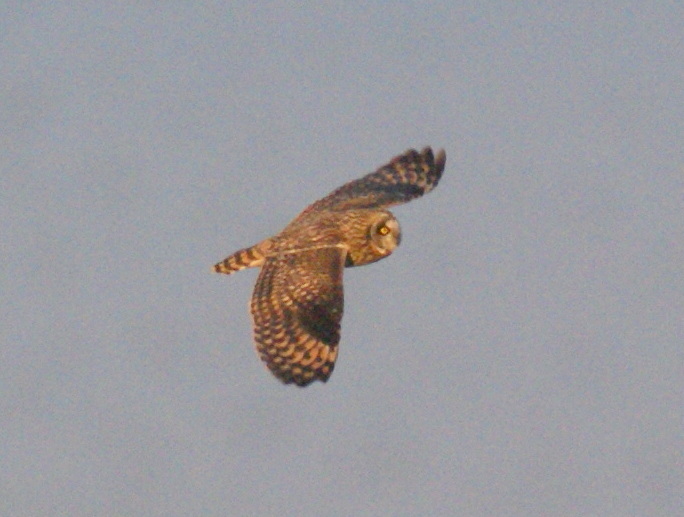
Yesterday morning I went back to Porter Road in hopes of getting a better look. I arrived at 7:20 and immediately spotted one of the owls scouring a field west of the road. The second owl appeared and I watched for several minutes as the pair crisscrossed the field. I was thrilled to get some reasonably clear photos.
One thing that surprised me was the length of the owls' wings.
As I watched over the next 15 minutes, every so often the two birds would fly directly towards each other. Then, just when they looked certain to crash into each other, they would both switch into a steep climb and then stop, to hang in the air for a moment, face to face and only a foot or two apart. Quite a sight!
After 25 minutes of watching the owls, they moved away to the far side of the field and I decided it was time for me to go to work. I got in my car and started to leave. However, I had driven only a few yards when I noticed that one of the owls was now heading back my way. I leaped out of the car and took more photos as the bird flew past me, crossed the road and started scouring the opposite field.
It just goes to show that, where birding is concerned, if at first you don't succeed, try again - and again - and again - and ...
.
Subscribe to:
Posts (Atom)