.On Saturday morning I spent an hour at Kleb Woods with a couple of other birders. Overall it was fairly quiet for birds (except Northern Cardinals), perhaps partly because it was very cold and windy. However, we saw a few interesting birds.
Near Moccasin Marsh there was an Eastern Phoebe, a House Wren, a Lincoln's Sparrow and several Vesper and Field Sparrows. We got a quick look at a Pileated Woodpecker and then a much better look at a Northern Flicker (below). The latter was year bird #148 for me.
Back at the parking lot entrance the area around the rosebush was busy with a range of birds - Northern Cardinals, Mourning Doves, House Sparrows, Field Sparrows and White-throated Sparrows.
I've seen more Field Sparrows this winter than in all my previous years of birding but I never tire of watching and photographing them.
The most numerous species around the bush was White-throated Sparrow. There must have been somewhere between a dozen and twenty of them. I had to use flash to get photos, because the morning was fairly dark and the sparrows mainly skulked in the shade.
.
.
Recent birdwalks at Kleb Woods have produced lots of birds - on Wednesday they found 90 species! So I spent a couple of hours on a birdwalk there yesterday morning.
The walk started off very disappointingly with only a few common birds: N Cardinals, Carolina Chickadees, Blue Jays, House Sparrows, Red-bellied Woodpeckers, and Mourning and White-winged Doves.
We walked towards the wetlands area between the two sections of the park, seeing a Loggerhead Shrike, a Killdeer and a Great Blue Heron along the way. Our arrival at the wetlands scared away a Little Blue Heron and a Green Heron that had been feeding. Brown-headed Nuthatches nest here but I've never managed to see them. Yesterday the walk leader, Kendra, called up three Nuthatches for me in a couple of minutes.
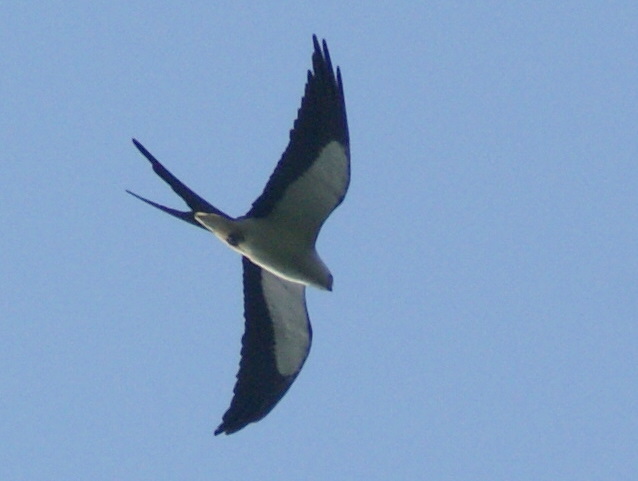
An Eastern Bluebird appeared, followed by Red-headed and Red-bellied Woodpeckers, and an Orchard Oriole. American Crows were cawing nearby while the sky overhead had Black and Turkey Vultures, and then a Swallow-tailed Kite.

 The trail also had a Gray Catbird. (The photo below is of a Catbird I saw on the CyFair campus early on Thursday.)
 A Mississippi Kite flew over, too high for photographs.
Back near Lumpy Kleb's house, we had brief views of a male American Redstart. This ushered in a brief spell of activity with Rose-breasted Grosbeak, Baltimore Oriole and Blackburnian Warbler.
Unfortunately, I had to leave at this point. However, as I was pulling out of the parking lot, I had good views of a dozen or so Black Vultures feeding on an armadillo carcass.
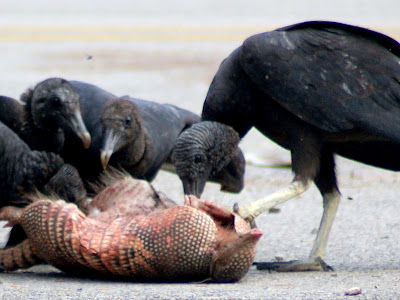

 Thank goodness for vultures! Without them we would be axle-deep in roadkill in Texas at this time of year.
.
P.S.
More about my Mexico trip tomorrow.
.
.
As Sunday dawned gray and very cold, it took a lot of willpower for me to get out of the house to do some birding. I really hate cold weather! However, the possibility of adding more birds to my year list provided just the motivation that I needed - which I think is a very good reason for keeping a year list.
So I drove 10 miles up to Kleb Wood to look for sparrows. Kleb is a good site for common birds and it is particularly good for sparrows in the winter. The staff at the nature center often throw seeds under a rose bush just behind the center's mailbox and this brings in lots of sparrows and other small birds. I stood near the bush for half-an-hour and saw a nice succession of birds, although the light was so bad that I couldn't get clear photos. The fact that I was soon shivering probably didn't help either!
First up were Northern Cardinals, Carolina Chickadees, Savannah Sparrows and Chipping Sparrows. One of the male Cardinals at Kleb has very odd pale pink coloring.


Then a very different bird appeared: Harris's Sparrow. This is a much less common species in our area, although I have seen quite a few this winter.
 A few minutes later a couple of new birds joined the others under the bush: White-throated Sparrows. That brought my year list to 110 - and gave me a good excuse to head for the warmth of home.
 Back in our subdivision, I stopped for a minute at our local lake/retention pond, where I was greeted by a Great Blue Heron and 42 Black-bellied Whistling Ducks.
 Two of 42 Whistling Ducks
When the light improved later in the morning, I spent a lot of time watching the birds in our yards. The front yard was - as usual - dominated by numerous White-winged Doves. The feeders in back attracted a much wider range of visitors: Northern Cardinals, House Finches, Carolina Chickadees, a Northern Mockingbird and a House Sparrow. One of the American Goldfinches
A Yellow-rumped Warbler came in to scavenge for seeds on the ground and to perch on our fence.

Our Ruby-crowned Kinglet was as willing to pose as ever and this time he really showed off his crest. What a beautiful little bird he is!
 Our Orange-crowned Warbler visited the suet feeder every few minutes but still shied away every time I approached with the camera. So one of my birding goals for this week is to get a good close-up photo of him.
Oops!
I just realized that I also saw Greater White-fronted Geese at Sheldon Lake on Saturday. So my true year total is 111 species.
.Lured by recent reports of lots of sparrows at Kleb Woods, I headed up there at 8:15 on Sunday morning.Although it was cold and foggy, I was assured by the weather forecasters that the day would soon become sunny and warm.

The forecasters were wrong. It stayed foggy and distinctly cool for the whole two hours that I spent there. However, this did not deter birds from appearing in numbers.
An initial walk around the main trail produced a Red-bellied Woodpecker, Orange-crowned Warblers, Ruby-crowned Kinglets, American Crows, Blue Jays and an Eastern Phoebe.
The edges of the path were lined with scores of spider webs. Combined with the fog, this gave the place a rather spooky atmosphere and I wouldn't have been too surprised if the ghost of old Elmer "Lumpy" Kleb himself had appeared.

I moved on to walk the path up to the site's wetland area.


The wetland was quiet once a Great Egret and a pair of Blue-winged Teal had flown off, disturbed by my presence.The hedgerow was a different story and was busy throughout my visit. Common birds were plentiful: Yellow-rumped and Orange-crowned Warblers, Carolina Chickadees, Northern Mockingbirds, Eastern Phoebe, American Robins, Tufted Titmouse, lots of Ruby-crowned Kinglets, and even more lots of Northern Cardinals.
The calls of Carolina Wrens brightened up the morning and I also spotted a Sedge Wren and a House Wren. Eight Snow Geese were just visible as they flew overhead in the fog. Then, finally, another bird that I had been looking out for over the past couple of weeks, Cedar Waxwings. Once you see Cedar Waxwings around, you know for sure that winter has arrived in southeast Texas.
I walked back to the main site to bird the area just behind the mailbox right at the main entrrance to the parking area. In the winter, this is always a great spot for sparrows.
As I approached, a crowd of Northern Cardinals and sparrows flew up from the ground and disappeared into the nearby bushes. I settled down to wait, hidden behind the electricity boxes, and it wasn't long before the birds resumed their ground feeding.
Several Northern Cardinals were the first to return but they were soon followed by Chipping and Song Sparrows. Then two species I hadn't yet seen this fall: White-throated Sparrow and Lincoln's Sparrow. Unfortunately, as you can see from the photo below, the light was really too bad for photography. White-throated Sparrow
Overall, not a bad couple of hours' birding: 23 species, including 4 FOS (First of Season) birds.
.
At 8:30 a.m. on Saturday I was sitting near the hummingbird garden in Kleb Wood. It was a wonderfully cool and damp morning, and I was being treated to quite a display.
The main actors were Northern Cardinals and Ruby-throated Hummingbirds. About a dozen (mainly male) Cardinals were flitting around the trees at the edge of the garden and flying to and from the seed feeders. Inevitably, given the number of birds involved, there was a lot of squabbling and jockeying for position.
Female Ruby-throated Hummingbirds were even more numerous and even more argumentative. There was no real reason for them to squabble, because Fred Collins and his staff have put out so many sugarwater feeders that each bird could probably have had its own feeder. Plus there were plenty of nectar-laden flowers. But most of the humminbirds seemed to have decided that a few of the feeders were superior to the rest and worth arguing over.
 So for the next hour I watched as some hummingbirds tried to assert their rights over three feeders within 7-8 feet of me while the other hummers tried to drink from them.
 Some of the "intruders" were sneaky and would try to reach a feeder without being noticed by the bird guarding it from a nearby twig. The guarding bird would swoop on the intruder and the latter would instantly fly away, often passing within inches of my head.
 Other intruders were much bolder and would openly confront the guard. When challenged, they would hover and spread their tails. The guard would hover facing her and would spread her tail, too. In most cases, the intruder would back down and be chased away. However, sometimes the intruder would get the better of the encounter and it would be the guarding bird that backed down and was chased away. Then the intruder would perch on a nearby twig and try to defend the feeder from other hummers.
 If Cardinals and hummingbirds were the main actors, they had a good supporting cast. This was made up of several Carolina Chickadees and Tufted Titmice. These two species behaved in much the same way. They would perch in and make a few calls from one of the trees near the garden. Then they would swoop onto a feeder, grab a seed and immediately fly back into the trees to enjoy their snack.
Meanwhile, Red-bellied Woodpeckers and Blue Jays acted as a chorus, flitting around high in the surrounding trees and filling the air with their harsh calls.
I had gone to Kleb in the hope of seeing unusual migrants but in the end I saw only common birds. I wasn't at all disappointed, though, and I'll remember my hour at the hummingbird garden as one of the most enjoyable spells of birding that I've had this year. The only disappointment - and it was minor - was that the light was so poor that I was able to take very few photos and none at all of the hummers in flight.