.
On Sunday afternoon in Parque Los Colomos, most of the species I saw were ones I had seen there the previous day: Lark Sparrow, Rufous-backed Robin, Lesser Goldfinch, Indigo Bunting, Vermilion Flycatcher, Great Kiskadee, House Finch etc. There were more Russet-crowned Motmots, too.
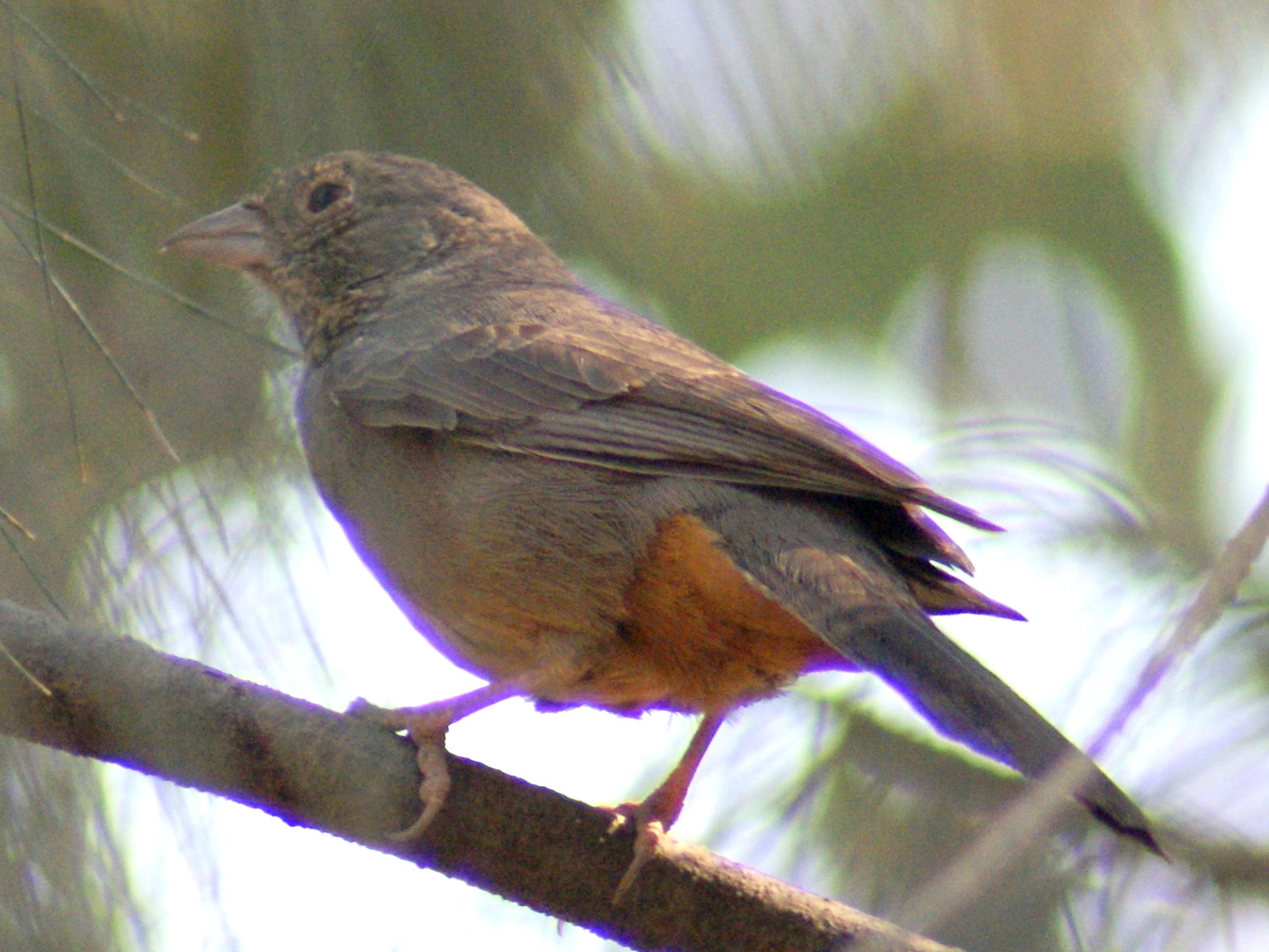
However, there were a few new birds, such as Bewick's Wren, Broad-billed and Violet-crowned Hummingbirds, and this Canyon Towhee.
Some warblers can be very tricky to ID but the black cap and eye of the Wilson's Warbler make identification easy.
The cactus garden in the park was impressive.
I've seen a lot of bougainvilleas but I'd never before seen one this big.
This particular plant had managed to climb right to the very top of a 130-foot tree.
Lizards and mammals were remarkably scarce in the park except for a squirrel that clearly appreciated the way a young man provided it with water in a bottle top.
Monday Morning
Before work on Monday I explored a small, one-block park near the hotel where I was staying. As I expected, it had plenty of common birds, including Rock Pigeons, House Finches and these Inca Doves.
I was surprised, though, to see that it also had some interesting birds. I hadn't expected to see Vermilion Flycatchers there, and I certainly hadn't expected to see two new life birds: Gray Silky Flycatcher and Blue Mockingbird.
All in all, I really enjoyed my visit to Guadalajara and I hope I'll be able to return there before too long.
.
.
At 8:00 a.m. last Sunday I was standing at the entrance to the Universidad Autonoma, feeling dismayed by large signs that said that unauthorized entry was not allowed and that no photos could be taken without a special permit. However, I decided to try my luck anyway. Carrying my camera in a Randalls tote, I said "Buenos dias" to the four armed guards and strolled past them and onto the campus.
The botanical gardens were just inside the campus gates and I spent the next hour birding and taking photos there, taking care to keep out of sight of the guards.
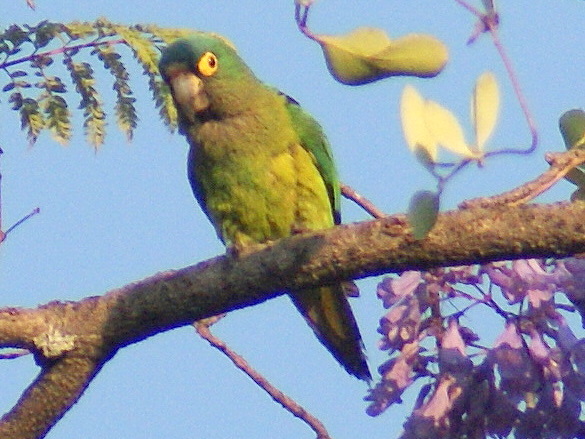
The gardens were busy with birds, including House Finches, Vermilion Flycatchers (below) and (below) Golden-fronted Parakeets, the latter a life bird for me.
I was delighted to see two more life birds: Aztec Thrush and Thick-billed Kingbird.
I wasn't able to get a decent photo of any of several Broad-billed Hummingbirds that were perching high in yuccas but I was luckier with a Russet-crowned Motmot.
After this, I decided to explore the rest of the campus. Like many streets in Guadalajara, the campus roads were lined with jacarandas and other wonderful trees.
One of the trees had a Plumbeous Vireo.
I noticed that one of the buildings had a number of Cave Swallow nests and I wandered over to take some photos.
Unfortunately, this immediately attracted the attention of two security guards and I was politely but firmly expelled from the university grounds. I didn't really mind this but it made me change my plans for the rest of the day. I had intended to bird the premises of the Jesuit university but I now realized that I was likely to be as unwelcome there as I was at the Universidad Autonoma.
After consulting a map, I decided to walk back to Parque Los Colomos, where I had spent the previous afternoon and had seen plenty of interesting birds. Although the park was bound to be very crowded with local families, I was sure I could find some quiet sections where I could watch birds.
.
.
Since Guadalajara is in a temperate mountainous zone, I wasn't expecting my visit there to produce as many exotic and spectacularly colored birds as I have seen on trips to the Yucatan. However, I was hoping to see one remarkable bird: the Russet-crowned Motmot. In the past, the only Motmot I had ever seen was a single Turquoise-browed Motmot that I got a short look at in the jungle around the ruins at Coba.
Unfortunately, on Saturday four hours of intensive birding in Parque Los Colomos didn't turn up a Motmot. I did see some good birds, though, including several that I rarely get a chance to watch.
I spent a long time watching a Great Kiskadee fussing around and flycatching only 7-8 feet away from where I was crouching amid thick foliage.
A pair of Vermilion Flycatchers brightened up my afternoon.
I had great looks at some Lark Sparrows, one of my favorite sparrows.
A Bronzed Cowbird and a Dusky Flycatcher, while not colorful, were good sightings, too.
The Rufous-backed Robin is a bird that is hardly ever seen in the USA.
I normally have to travel to Arizona to see a Gila Woodpecker.
By 5:30 I was hot, tired, thirsty and hungry. So I decided to head back to the hotel. Perhaps I would have more luck with finding a Motmot the next day, when I planned to visit two different sites.
As I started walking towards the park entrance, a fairly large bird flew into the trees a few yards ahead of me. A Russet-crowned Motmot! I rushed to take a photo before it disappeared. In fact, I needn't have hurried, because the bird wasn't going anywhere and it hopped around in front of me for a couple of minutes.
What a magnificent bird!
.
.
I was lucky enough to have business in Guadalajara on Monday and so I added on the weekend in order to do some birding. I was very impressed by the beauty and cleanliness of the city, which also has a reputation for being one of the safest cities in Mexico. (Drug violence has not reached it and the rate of "normal" crime there is very low.)
I birded one of the many city parks - Parque Los Colomos - for 4 hours on Saturday afternoon. On Sunday I did an hour's excellent birding on the grounds of the Universidad Autonoma before I was asked to leave by security guards: You need a permit to visit and to take photos! I followed up with another 4 productive hours back in Parque Los Colomos; even though the park was very busy with Mexican families, I was able to find plenty of quiet nooks that were full of birds. Then on Monday morning I fitted in a couple of hours in a one-block park near where I was staying and working.
Some of the birds were ones that I often see in Texas, such as Great-tailed Grackle.
Others were ones that I only occasionally get to see in southeast Texas, such as Ladder-backed Woodpecker, Vermilion Flycatcher and Cave Swallow.
There were several species that I normally have to travel further afield to see, such as Lark Sparrow and Great Kiskadee.
Then there were birds that were completely new to me, including the Orange-fronted Parakeet.
The bird that I particularly wanted to find and photograph was the Russet-crowned Motmot. Did I find it? Well, I'll tell you tomorrow or Saturday, when I post further about my Mexico trip. After that, it'll be a few days before I can post the rest of my report, because we're spending the weekend at High Island, hoping to catch the end of the spring songbird migration. With southerly winds forecast, the weather doesn't look favorable for migrants. However, the trip should still be worthwhile since there will be lots of activity at the wading-bird rookery at High Island and we may also fit it a quick tour of Anahuac NWR. Wish us luck!
.
.
Friday morning was my last chance to look around the CyFair campus before my Mexico trip. It was glorious weather and there were plenty of birds around. As usual this spring, though, the wind was southerly, which meant that there was again little chance of seeing migrants.
Most of the birds were common residents and they were all in very good voice. Red-winged Blackbirds were trilling away everywhere, although I didn't actually get to see any of them. Purple Martins flew overhead every couple of minutes, filling the air with their chattering. A Carolina Chickadee surprised me by perching and singing a beautifully slow and soulful version of "chick-a-dee" rather than the typical fast and staccato "chickadee - chickadee - chickadee - dee - dee".
High on a tree, a Western Kingbird contributed its rattling calls before dashing away when it noticed me. No doubt our Kingbirds will be more tolerant of my presence once they've settled in and start working on their nests.
Dominating the whole area were the songs and calls of male Northern Cardinals. They generally started with the usual "pretty - pretty - pretty" song. But then they went through several others: a strident "look-at-me look-at-me," a rapid "cookery - cookery - cookery" and a medium-paced "chee-you chee-you choc choc choc".
Flyovers included Mourning and White-winged Doves, Black-bellied Whistling Ducks and a Red-tailed Hawk.
Migrants were as scarce as I had expected but I was pleased to get a distant sighting of a male and two female Indigo Buntings and a close-up look at a Pine Warbler.
My final sighting as I walked to my office was of a Double-crested Cormorant heading towards our retention ponds.
.
.
Now that spring is well and truly here, our yards are full of birds. Our House Finches have had several babies and both parents and offspring spend a lot of time on our seed-feeders and on our hummingbird feeder. (The latter has only attracted one Ruby-throated Hummingbird this week.)
There seems to be at least one Northern Cardinal in our front yard whenever I look out.
We've even had a pair of American Robins, birds that rarely visit our yards.
The highlight of every day, however, has been visits by a family of Carolina Wrens. The parents take their two offspring on a tour of our yards at least once a day. They lead them from the fences to the feeders and back to the fences by way of most of our hanging baskets and potted plants. Each parent normally watches over one baby but the adult male will sometimes take a couple of minutes off to sing from the top of a fence. A beautiful sound!
The Wrens had three young this year but the other day we found one of the babies dead in our backyard. It was no doubt killed by one of the cats that visit our property.
Away Again
When you read this, I'll be in Mexico. I have to visit a teacher-training course in Guadalajara, a city that I don't know at all. Although the trip is for business, I've added on one day for birding the local parks. I'll report next week on what I see.
.