Sunday, August 21, 2011

Watching Elk in the Rockies

.
When you read this, I should be in Colorado, visiting Rocky Mountain National Park. I won't be home until Tuesday. In the meantime, here's one of my posts from a visit I made to the park last fall. This year I'll probably be too early for most of the elk action but I'm hoping that I'll see plenty of birds instead.

I drove into the Rocky Mountain National Park at 6:45 on Sunday morning and immediately came across a group of elk grazing by the roadside. Suspecting that these might be the only elk I would see in the park, I grabbed a couple of quick shots in the low dawn light.


I needn't have worried! Over the next 6 hours I was to see a lot of elk: dozens, perhaps scores. My second sighting came as I was driving up to Upper Beaver Meadows and pulled into a picnic area to let another vehicle pass. To my surprise, three more elk were wandering among the picnic tables.


When I arrived at Upper Beaver Meadows, I was greeted by the sight of another group. Several does grazed peacefully while two young males practiced butting heads and the bugling calls of older bulls echoed eerily all around.
After leaving Upper Beaver, I drove around several different areas of the park and saw (and heard) many more elk. Some, like the doe below, were in groups.

Several were lone males.

After driving up to the Alpine Center and back, I returned to Upper Beaver Meadows just after noon. Following a small path into the woods, I hadn't gone 50 yards before I found I had strayed right into the middle of a group of resting elk.

None of the does seemed to notice me but a young male made me a little nervous when he showed some interest in my presence, stood up and walked over to check me out. I sat quietly down beside a tree and he seemed to forget about me.
BTW, until this point I had always thought of elk as being just like deer. However, seeing this young male up so close made me realize that elk are big - really big. In fact, they're at least a foot taller at the shoulder and more than twice as heavy as white-tailed or mule deer.

It wasn't until the young male wandered away that I was able to examine the group more closely - and to realize that he was not the animal I should have been worried about. The one that I should have been nervous of was a large bull sitting with a doe perhaps 40 feet away.
He looked me over quite carefully but must have decided that I wasn't a threat because he didn't even bother standing up.After I had been sitting with the elk for a while, another bull started bugling loudly from the edge of the trees. This really agitated "my" bull, who stood up and started bugling back.
Then he got to his feet and led his herd away, stopping every few yards to bugle back at the unseen male.


Deciding that anything else I saw in the park was going to be an anticlimax, I headed back to the car.
.

Saturday, August 20, 2011

CyFair

.
Over the past week or so I have been reading reports about the presence of migrant warblers and flycatchers in different areas around Houston. Unfortunately, I've been too swamped with work to visit the places mentioned in the reports. (I hate it when my college work intrudes on bird migration!) However, on Thursday morning I did manage to fit in a quick walk along the nature trail on the CyFair campus.

On my way to the trail, I passed by several Northern Mockingbirds and was overflown by a Black-bellied Whistling Duck.


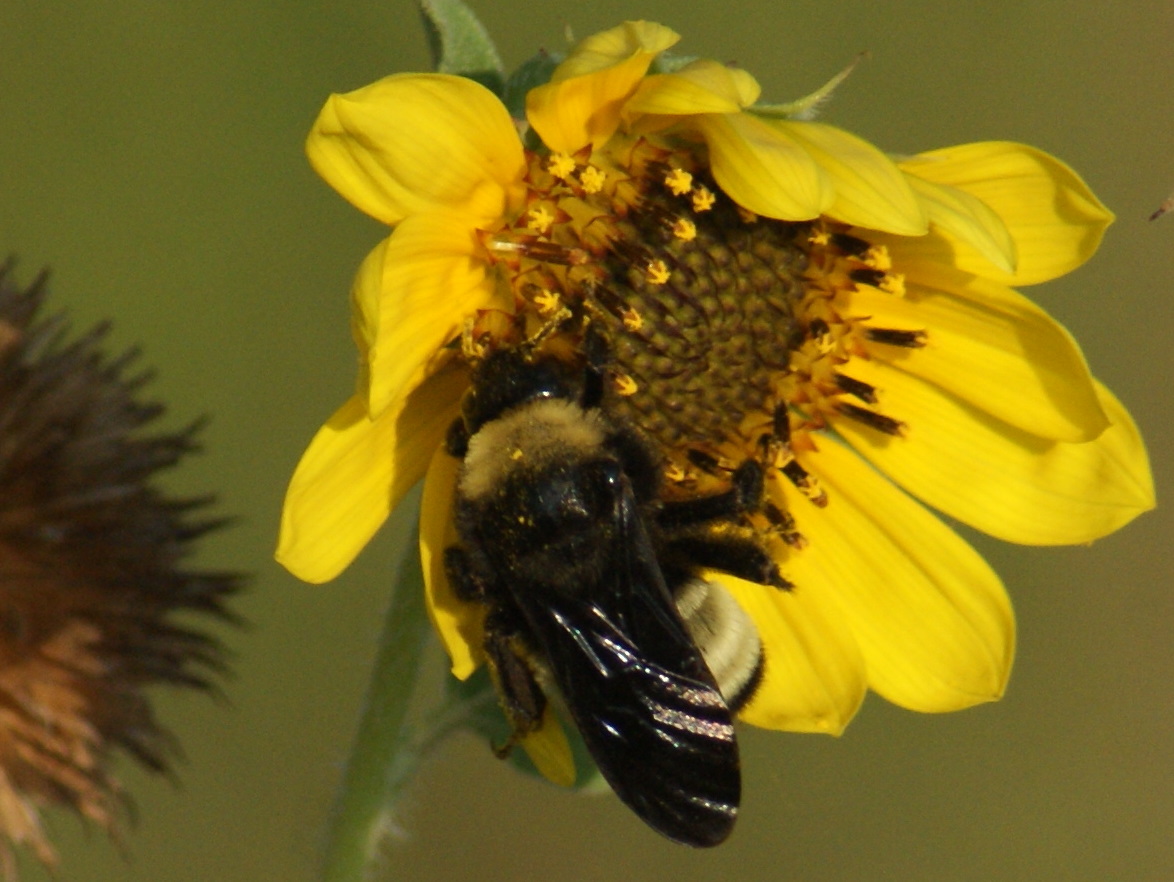
At the trail entrance I was pleased to see that sunflowers were attracting both wasps and bees.


The trail itself was very quiet, except for a few Northern Cardinals and Mourning Doves and a several rabbits. 


The only sign of migration was a couple of Blue-gray Gnatcatchers working through the trees.


Walking back to my office, I spotted this Great-tailed Grackle hurrying away with a prize catch.

.

Wednesday, August 17, 2011

Sunday, August 14, 2011

Heartbreaking!

.
Over the past weeks we've had many more birds than usual in our yards and at our feeders and birdbaths. This has made for entertaining viewing but it has also led to a major problem: avian pox. This is a disease that can spread quickly from individual to individual when birds are sharing (and pooping on) feeders and birdbaths. It is particularly prevalent among House Finches, of which we have a bumper crop this year. While not usually fatal, avian pox typically causes temporary blindness, which obviously increases an affected bird's chances of dying from predation, hunger and/or thirst.
.
I mentioned a few weeks ago that we had a couple of juvenile House Finches that were blind as a result of avian pox. We kept filling (and cleaning) our feeders and birdbaths in the hope that these birds would recover and both of them have coped remarkably well. However, on Monday I noticed that another young Finch was having eye problems. Then I spotted an adult male Finch hiding, blind, in one of the flower beds.
.

As the pox was clearly spreading throughout our flock of Finches and could have even affected our other yard visitors, we took down our feeders and emptied the birdbaths.

The next several days were really very sad as we watched bird after bird arrive in our yards and search in vain for the feeders, or check out the top of our fence for peanuts, or fly onto the birdbaths only to find they were empty. And it was totally heartbreaking to watch the blind Finches fluttering desperately around where the feeders had been and to know that we might well have condemned them to death from hunger and thirst.

By yesterday our yards were almost empty of birds all day. The only ones we saw were a pair of Carolina Chickadees foraging in the leaves of a yucca and the occasional White-winged Dove sitting forlornly on one of our fences.

However, there has been one good effect. Our American Beautyberry had been ignored as a food source, even though it was covered in plump berries. When I looked yesterday, it had been absolutely stripped of fruit. So some of birds - perhaps the Northern Mockingbirds and Cardinals - had clearly reverted to looking for natural food in our yards.

We're going to leave our feeders down and birdbaths empty for at least another week. Hopefully by then the Finches will have been dispersed for long enough for the pox to have subsided. Then we will experiment with putting out a little food and water but will watch to make sure that the House Finches do not return en masse. In the meantime we're certainly going to miss them and our other regular visitors.
.

Tuesday, August 09, 2011

Elm Lake

.
We finished off our visit to Brazos Bend State Park with an hour-long walk around Elm Lake, where we were greeted by an Anhinga which was perched on a snag and drying its wings.


Nearby a spider was busy wrapping up a dragonfly that had strayed into its web.


Most of the ten or so alligators that we spotted were small juveniles but a couple were mid-sized adults.


We came across few large wading birds except for a Little Blue Heron standing motionless next to the path.


We stopped to watch a Green Heron but it took umbrage at our presence and flew off. Judging from the fact that it had a definite crest, I assume it was a juvenile.


As at 40 Acre Lake, the most numerous birds were Common Moorhens. A few adults were paddling about by themselves but most were accompanied by their families.

One pair of adults had two of the youngest chicks I have ever seen.


Moorhen chicks do not have the beautiful plumage  of their parents but they make up for this by having huge legs and feet!


P.S.
I won't be posting as often as usual over the next two weeks because I'm going to be too busy with work to do much birding. However, I'm ending the month with short trips to Rocky Mountain National Park in Colorado and Glacier Park in Montana. I'm looking forward to the trips because they'll provide a welcome break from the heat - and from the flat landscape around Houston. Both parks should have some interesting birds and, if I'm lucky, I may even see bears in Glacier.
.

Sunday, August 07, 2011

The Park that Never Disappoints

.
Yesterday was another blazing hot Texas summer day. However, in spite of the heat, we spent a very enjoyable 4 hours  walking with friends in Brazos Bend State Park. I think all of us were half-expecting that the heat and the continuing drought might mean there would be little to see there. We needn't have worried. Although there was much less water in the lakes than normal, the park provided us with plenty to look at and watch. An added bonus was that there were very few other people visiting.

We started off by walking round 40 Acre Lake. The water level was exceptionally low and most of the surface was covered in either green algae or water lilies.


The algae provided excellent cover for the 25 alligators that we saw on our walk.


With the exception of one large adult, the gators were small juveniles, like this 4-footer.


The lily pads were acting as stepping stones for drab juvenile and more colorful adult Common Moorhens.


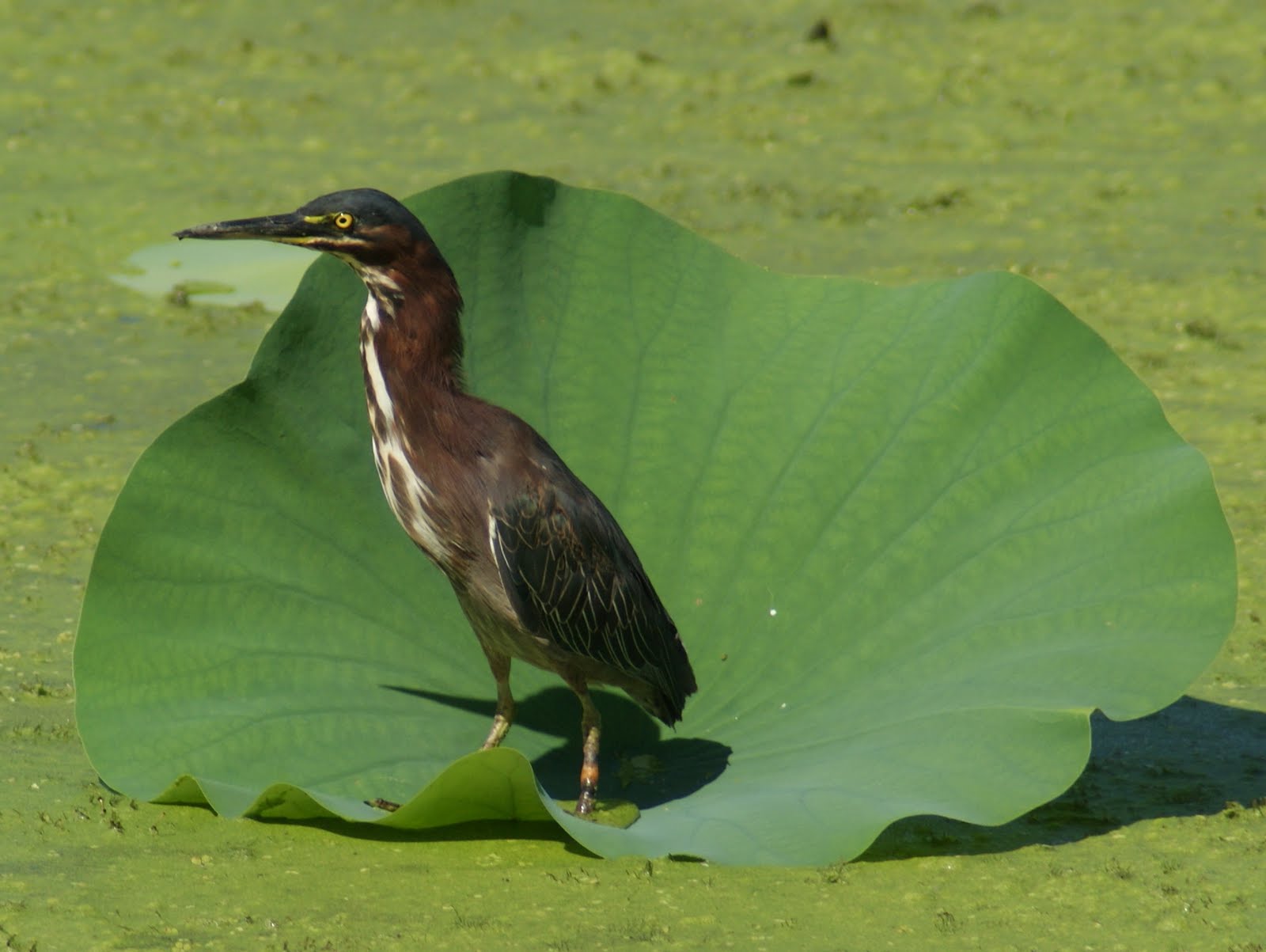
The Green Herons that are always plentiful in the park in summer were also foraging on and around the pads.


I'd never really noticed before how much Green Herons resemble Least Bitterns when they stretch up their necks.


The pale green patch in front of the Herons' eyes was also very visible.


Other birds including large waders were less common than on most visits to Brazos Bend. Apart from several Northern Cardinals, we saw only a handful: Black-bellied Whistling Ducks, Little Blue Herons, Great and Cattle Egrets, White Ibis, Anhinga, Great Blue Heron and a juveniles Yellow-crowned Night Heron.

Great Blue Heron

I was surprised not to see a single turtle on our walk. Mosquitoes were absent, too. However, dragonflies were everywhere.


After completing our leisurely circuit of 40 Acre, we headed over to Elm Lake, where we hoped to see more wildlife. As you'll see later, we weren't disappointed.

Friday, August 05, 2011

Constant Traffic

.Perhaps because of the drought, our yards continue to host a constant stream of birds from dawn to dusk every day. For the past month we have had 12-15 species and 50+ individuals every day. That's a lot more birds than we normally see in the summer and it includes an unusually high proportion of fledglings and juveniles. Hardly surpisingly, we're getting through large amounts of sunflower seeds, peanuts and suet!

Our normal flock of 8-10 House Finches has increased to 14-15, of which only two are adult males.


One of the young Finches appears to be almost completely blind at present with what I assume is avian pox. When it is on the feeders, I can walk right up to it and put my hand within 6 inches of the bird without it noticing me. I don't know how it manages to survive but it somehow finds its way to the sunflower feeders several times every day and refuses to yield its perch when her Finches try to usurp its place. We're hoping it can stay alive long enough to recover from the pox. 

We seem also to have only two pairs of adult Northern Cardinals but at least half-a-dozen youngsters.


Two pairs of Northern Mockingbirds each have one juvenile, easily identified by their spotted breasts.


One of the juveniles has lost its tail.


A couple of our young Finches have also lost their tails. Seeing this, and noticing a scattering of feathers here and there in our yards over the past week or two, I assumed that our neighborhood cats had been busy. However,  yesterday a Cooper's Hawk swept low over our back yard and perched in a nearby tree and so perhaps this explains the missing tails and scattered feathers.

Our Red-bellied Woodpeckers have a single juvenile and one or other member of the family is usually somewhere in our yards.


In the six years we've lived in Cypress, our most regular and frequent visitors have been Downy Woodpeckers, which absolutely love our suet feeders. I was therefore very disappointed when I hardly ever saw a Downy in the whole of July. I thought they must have moved to another area. So I've been thrilled to see an adult male turn up several times this week.


I've been less thrilled to see that our local population of White-winged Doves is as large as ever. I don't really mind too much when they wander over our lawn but it irritates me that they spend  lot of time - usually unsuccessfully - trying to access our sunflower feeders, frightening away all the other birds as they do so..


Perhaps it is their constant presence that has attracted the attention of the Cooper's Hawk.
.

Wednesday, August 03, 2011

Monday, August 01, 2011

Robins

.
While most of the birds oncentrate on eating the seed or suet that we put out in our yards, the American Robins prefer to find their own food. And they are very good at doing so!

I was watching one of them yesterday and I was amazed by how successful it was at finding worms and bugs in our lawn.

It would walk slowly across the grass.


Every so often it would stop, presumably when it heard movement on or under the ground. It would cock its head to one side to listen for the exact location of its prey.


Then it would pounce and drag out the hapless worm or bug and eat it. 


As far as I could tell, the Robin caught something every time that it tried. That's a much high rate of success than most predators, many of which only catch heir prey once out of every ten attempts.