Monday, November 11, 2013

Birding at Work

.
One reason why I like working at LSC-CyFair is that I often get to see birds there, which makes going to work more enjoyable than it might otherwise be. Although the past few months have been unusually quiet on the campus, it seems I still see several birds every working day. For example, when I reached the campus on Friday morning, two Great Egrets were standing on light standards in the parking lots.


As I drove in this morning, I spotted an Eastern Phoebe fly-catching from the top of a tree.


A couple of minutes later, I came across the Osprey that has been hanging about on or near the campus for a year. I was lucky enough to get to watch it carrying out its morning grooming routine.


I can certainly think of many worse ways to start off a working day than by watching an Osprey!
.  

Friday, November 08, 2013

Looking for a Rare Bird

.
On Sunday morning I left home early to drive down to the San Jacinto Monument Park,  hoping to see the Surf Scoter that has been hanging out there. We saw Surf Scoters all the time in San Francisco but it's a very rare bird for southeast Texas. Unfortunately, when I reached the park at 7:30, I discovered it didn't open until 9:00. So I drove the short distance to the Lynchburg Ferry landing to see what birds were hanging out near there.

Eastern Phoebes were all over the place and some let me have good looks at them.


A Loggerhead Shrike was equally obliging.


I wasn't surprised to see that the roadside utility wires had a Belted Kingfisher. I knew that, in typical Kingfisher fashion, the bird would fly off if I approached it. So I used the enormous zoom on my new camera to grab a photo from far away.


When I was finally able to enter the park, I stopped to take photos of a group of Black Vultures on the road. It was interesting to compare the gray, heavily wattled heads of the adults with the blacker, more feathered heads of the juveniles.


Down on the water a number of White Pelicans were fishing as a group.


There was a steady stream of other White Pelicans overhead.


The Surf Scoter had previously been seen mainly with a raft of Ruddy Ducks, and so I scanned the several groups of Ruddy Ducks in hopes of spotting it. No luck! The water was choppy and the only ducks were far away from the shore.

Disappointed, I wandered over to the boardwalk, where I was surrounded by Marsh Wrens.


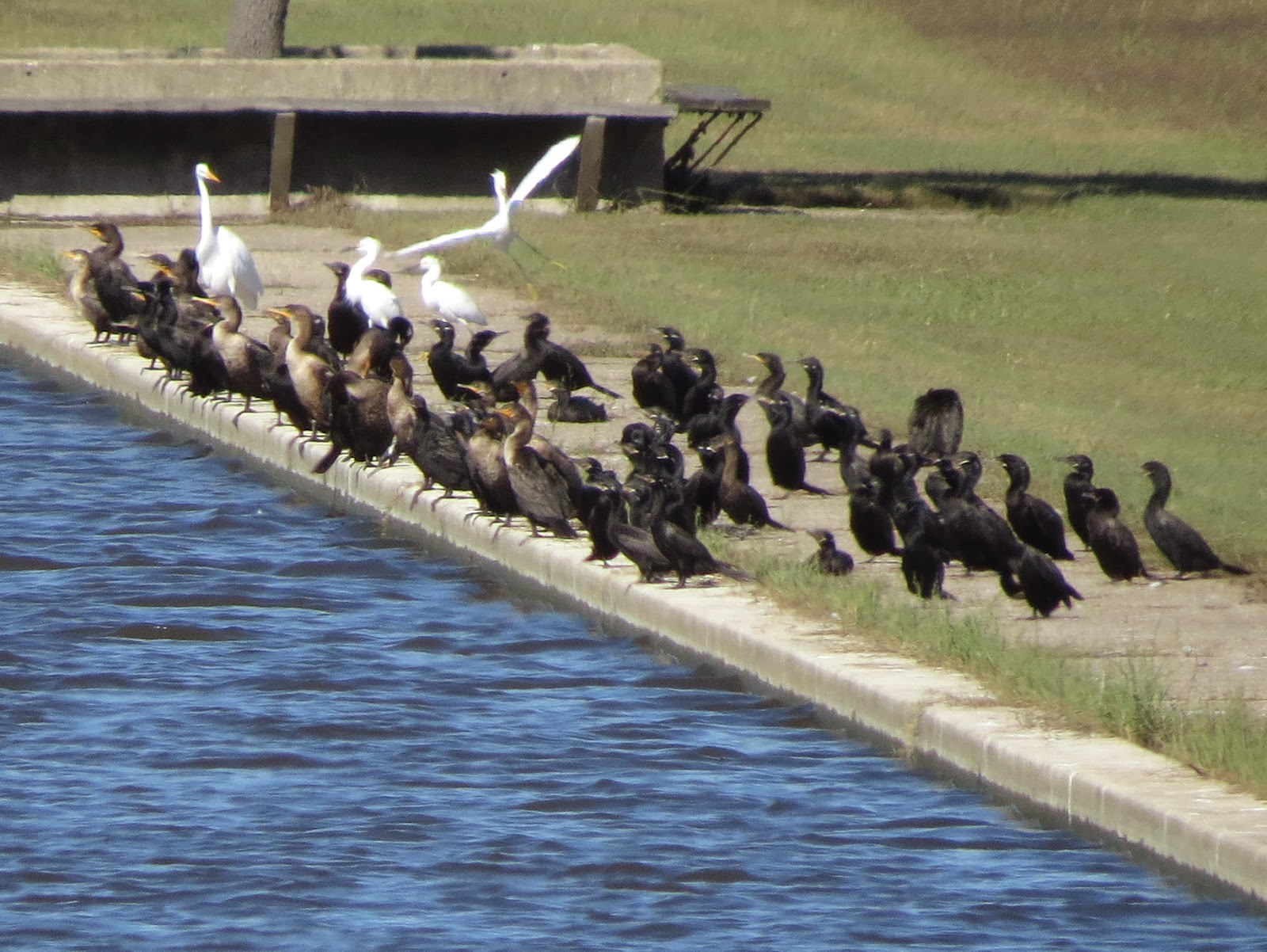
Then I headed to the reflection pool, the side of which was crowded with Neotropic and (much larger) Double-crested Cormorants, along with a few Great and Snowy Egrets. 


A flash of red on a chain-link fence caught my eye. A Northern Cardinal? No, it was a magnificent male Vermilion Flycatcher. I imagine it was the same bird that spent last winter at the park.


Before leaving, I decided to spend five more minutes looking for the Scoter. As it happened, I didn't need five minutes because the Scoter popped up immediately in the middle of a group of Ruddy Ducks. It was difficult to see the bird clearly but there was no mistaking the vertical white lines on its face. 


So, mission accomplished.
.

Wednesday, November 06, 2013

Flycatchers

.
As you might expect given the number of bugs we get here, flycatchers are a very common sight in our area from spring through fall. Of the many species that you are liable to see here at that time of year the most spectacular is the Scissor-tailed Flycatcher.


When winter approaches, the warm-weather flycatchers head south and few if any are still here by Christmas. Throughout most of the winter they are traditionally replaced by only one flycatcher species, the Eastern Phoebe.


However, in recent years there have been frequent sightings of several flycatcher species that wouldn't normally be found in our area. The most commonly sighted of these birds is the Vermilion Flycatcher. 


Male


Female

Vermilion Flycatchers now routinely winter at sites such as Bear Creek Park, El Franco Lee Park and Anahuac NWR.

Two other southern birds are also being seen with increasing regularity. 

Couch's Kingbirds often turn up on the Katy Prairie and at sites such as Bear Creek Park.


Great Kiskadees frequently appear on the Katy Prairie, too, but they are also spotted at Sheldon Lake and other local sites.


Say's Phoebes are less commonly seen but sometimes winter in our area. This one spent last winter in El Franco Lee Park.


If you go birding in our area this winter, you are likely to see all five of the species mentioned above. And if you are really lucky, you may even see some other flycatcher species. For example, last winter Bear Creek Park hosted a Greater Pewee, an extremely rare visitor to Texas.


.

Monday, November 04, 2013

Last Week at Work and at Home

.
The CyFair campus has continued to be quiet for birds. We do have a lot of Northern Mockingbirds, though, including this one with a damaged beak.


The parking lots have large numbers of Great-tailed Grackles. This female had a hard time subduing and eating a large dragonfly.  


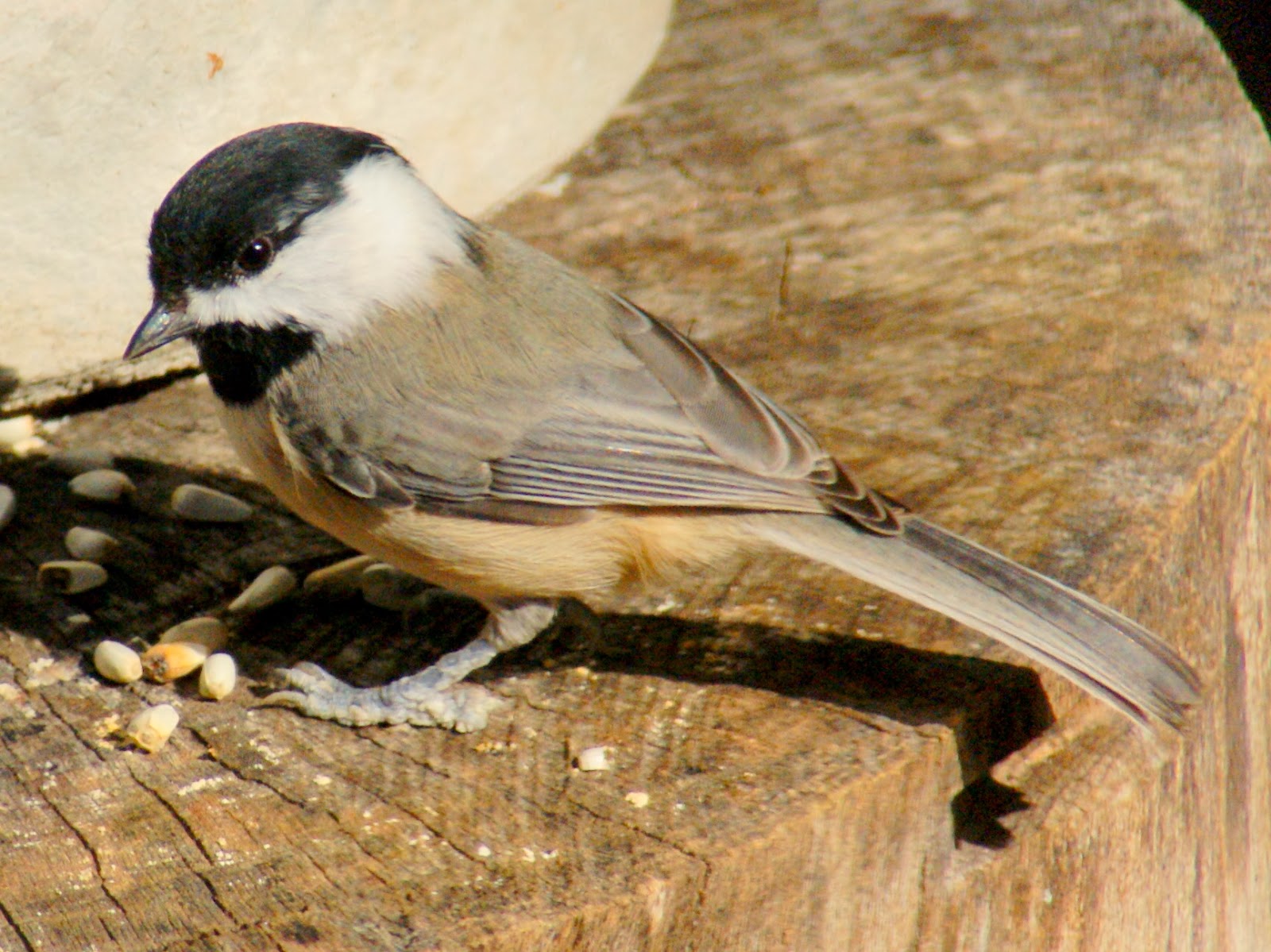
At home all our usual residents have been visiting the feeders, including a constant stream of Carolina Chickadees.


The Blue Jays enjoy both the peanuts we put out and our birdbaths.


We have a couple of families of House Finches.


Several Tufted Titmice have become regular - and very welcome - visitors to the feeders in our backyard.


This male Orange-crowned Warbler was the first of our winter residents to show up this year.


The second was a Yellow-rumped Warbler that appeared on Sunday.


I have seen several Ruby-crowned Kinglets at CyFair but the male that has spent the past five winters in our yards still hasn't shown up. I'm beginning to think that perhaps he didn't survive his time in the north or else died during migration. .

Friday, November 01, 2013

Baytown Nature Center

.
Baytown Nature Center was fairly quiet for birds, perhaps because there was a stiff breeze. We weren't complaining, though, because the breeze kept the mosquitoes at bay.

The Yellow-crowned Night Herons that had been everywhere on my previous visit were replaced on this visit by White Ibis.


Several Great Blue Herons and Great Egrets (below) took offence at our approach.


This Snowy Egret was less bothered by our presence.


The wind was making grooming difficult for an Osprey perched near the gazebo.


Close by, a Belted Kingfisher was getting blown around as it perched on a snag.


A walk around the site turned up surprisingly few birds but two butterflies, a rather worn Monarch and a Common Buckeye. 


As we were leaving, we stopped to admire a Brown Pelican fishing.


Our final sighting was of a Forster's Tern wheeling and diving again and again.


.