.
Last weekend I visited a site I'd never birded before: Brunswick Lakes. The site is just north of Beltway 8 a little east of 288. It isn't a very beautiful location but it attracts a good range of birds that like water.
The hundreds of gulls were mainly Laughing Gulls but there were two Franklin's mixed in with them.
I almost overlooked a couple of Caspian Terns also.
Birds on the water included a few Blue-winged Teal, a Gadwall and several American Coots.
A handful of Yellowlegs and other shorebirds were too far away to photograph and difficult to ID without a scope. Larger wading birds were easier to see and they were present in large numbers.
As well as a Great Blue Heron, a Reddish Egret and Little Blue Herons, there was a Tricolored Heron.
Snowy Egrets were present but were outnumbered by dozens of Great Egrets.
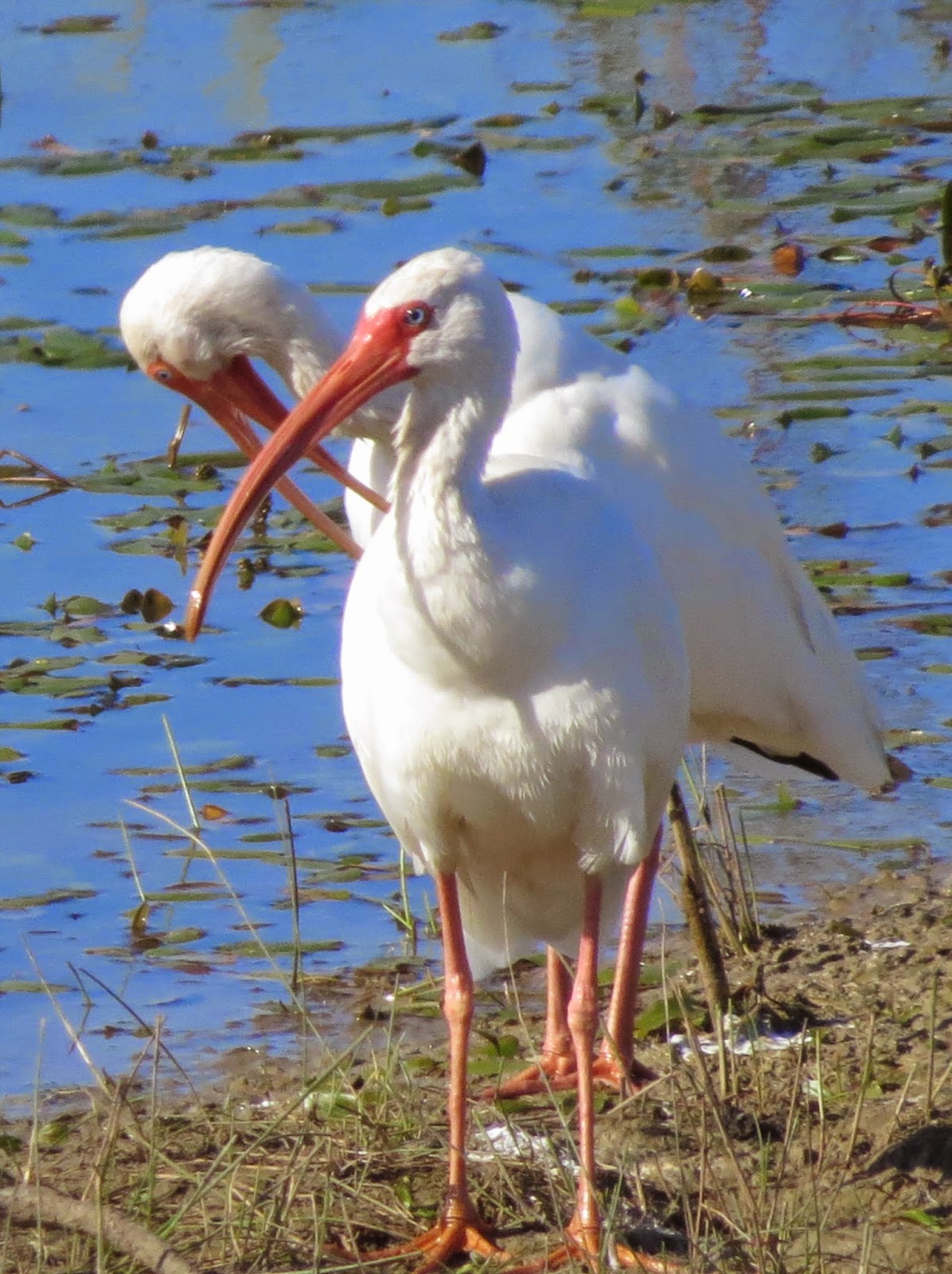
About a hundred White Ibis were grazing in the water.
At one point they formed a long line right across a section of the lake.
Mixed in with the White Ibis were three White-faced Ibis.
They were joined by some Roseate Spoonbills, too, while other Spoonbills grazed or preened nearby.
My final sighting was of an Eastern Phoebe, which perched near me for a while before flying off to harass a Northern Mockingbird.
I must remember to check the site out again before too long. It certainly seems to be one of the better inland water sites in Harris County. Also, it's only 45 minutes from our house - and that's just around the corner in Houston terms.
.
.
Last Tuesday I decided to spend lunchtime visiting the Precinct 3 park that is just across Barker Cypress Road from LSC-CyFair. I was hoping that the first of the winter ducks might have arrived.
A small bird was paddling around and diving, but it was a Pied-billed Grebe not a duck.
A raft of dark birds was floating around further down the lake. It didn't take long to see they were only American Coots.
But wait a minute. One of those birds was different. As I got nearer, I realized it was a female American Wigeon, apparently quite comfortable hanging out with 120 American Coots. So winter ducks had started arriving.
Just then an Osprey flew over, followed a little later by four Mottled Ducks. (The latter are year-round residents in our area.)
Three small birds were floating along together on the far side of the lake. As they drew closer, I could see two were a pair of adult Ring-necked Ducks. So no doubt the third bird was a juvenile Ring-necked.
As it turned out, it wasn't. In fact, it was a juvenile Ruddy Duck. Just like the Wigeon, this bird seemed to be happy to tag along with birds of a different species.
.
.
Sunday morning I had agreed to take some non-birders on a birding trip. The site I chose to take them to was Baytown Nature Center. Although I had been there several times recently, I picked Baytown as our destination. Apart from the fact that the site always has plenty of birds, the presence of large wading birds near the roadway and trails makes it a good place to take people who are not accustomed to using binoculars.
Waiting in the entrance parking lot for late arrivals, I passed the time by watching some Blue Jays, a pair of Red-bellied Woodpeckers, a Northern Mockingbird and a Red-headed Woodpecker.
When the group was assembled, we drove along to where the road passes between Pelican Cove and the Egret Tidal Flats pond. The water on both sides of the road had Brown Pelicans.
It also had numerous Great and Snowy Egrets. (As you'd expect from their name, Great Egrets are larger than Snowy Egrets. They also have a yellow, rather than a black, bill.)
A little further along the road we stopped to watch the birds in the new wetland area on the edge of Burnet Bay. Apart from the American Avocets I posted pictures of on Wednesday, there were several other species of shorebirds: Least Sandpipers, Semipalmated Plovers, Greater Yellowlegs, Killdeer (below) and a Willet.
Everyone enjoyed seeing a Great Blue Heron posing in the bay.
I was more excited to see a Reddish Egret, a bird I'd never seen on any of my previous visits to Baytown.
We drove on to San Jacinto Point, where we had distant views of one of the two adult Brown Boobies that have been present for a couple of weeks. The Boobies typically hang out in the company of Brown Pelicans and Cormorants on utility pylons in Burnet Bay. An Osprey resting on the nearest pylon proved to be a most cooperative photographic model.
After this we left the cars near the gazebo and walked down to Scott Bay and the Heron Haven Pond. The pond had a single Anhinga, while the mudflats on the edge of Scotts bay had Roseate Spoonbills, White Ibis, Willet and Spotted Sandpiper. Unfortunately, the lighting did not allow reasonable photos.
We completed the trip by walking the loop trail back to the gazebo. As it was now hot and after noon, we saw few birds except four Northern Rough-winged Swallows, a distant Northern Harrier, a Northern Cardinal and a couple more Ospreys. The exception was a flock of 60+ American White Pelicans that circled high overhead, well outside camera range.
I wasn't able to get photos of any of the butterflies that we passed, which included Monarch, Gulf Fritillary and Common Buckeye. I fared a little better with the praying mantis that one of our friends noticed.
.
.
On Sunday morning I led an informal birding trip at Baytown Nature Center. Our little convoy of cars had just entered the site when I had everyone stop to admire a dozen American Avocets that were stalking around in a wet area next to the road.
With their elegant build and plumage, Avocets are one of my favorite shorebirds.
I always enjoy watching as they feed by sweeping their upturned bill from side to side through the water.
Of course, Avocets were far from being the only birds that we saw at Baytown. Although we didn't start birding until after 10:30, we managed to spot quite a few species. I'll upload an illustrated summary of the trip later this week.
.
.
Saturday morning I went over to the Longwood retention pond on Hufmeister Road to see if Blad Eagles were around. A pair has nested there every year for several years now. The birds seem to disappear for a while in mid-summer, after raising their chicks.
Sure enough, one of the Bald Eagles was hanging out on the far side of the pond.
Nearby was what I took at first to be its partner but turned out to be an Osprey.
While I was watching, the Osprey flew off, immediately followed by the Eagle. I expect the latter was hoping to steal any fish that the Osprey caught.
On the way back to my car, I ran into a male American Kestrel that was perched on a fence. What beautiful birds they are!
Since I didn't have binoculars with me, I had to get quite close to the Kestrel before could see whether the bird was watching me or was looking in the other direction. This is because, as you can see from the photo below, the back of a Kestrel's head has two black spots that resemble eyes.
.
.
This is the time of year when our winter residents start arriving and so I wasn't surprised when an Orange-crowned Warbler appeared in our yards on a couple of occasions over the weekend.
I hope more winter birds arrive soon because our yards have been remarkably quiet of late. Apart from a Northern Mockingbird, a Carolina Chickadee, a Downy Woodpecker and a pair of Carolina Wrens, I haven't seen any of our year-round residents for weeks. Even our Blue Jays and Northern Cardinals seem to have deserted us.
One reason for the lack of birds may be the Cooper's Hawk that moved into our block some months back. On Sunday it was in our neighbors' yard, eating a rat.
It has been equally quiet on the CyFair campus. The only birds present in any numbers are Northern Mockingbirds and Great-tailed Grackles, although yesterday I get a brief glimpse of a Northern Flicker.
This Mockingbird greets me at the entrance to the nature trail every day when I get to work.
The Grackles prefer the parking lots, where they scavenge for fast food leftovers or just hang out on cars, like this fine male.
Our resident Black Vulture is hanging out in its usual place, on top of the TECH building.
A Cooper's Hawk has moved onto the campus but is too skittish to let me get a photo. Our Loggerhead Shrikes are more obliging.
We haven't been able to fit in any birding trips lately but we're doing one on Sunday. I'm leading a group of adults and children on a bird-walk at Baytown Nature Center. The weather looks to be perfect and I'm hoping I'll get to show the group plenty of birds.
.
.
The week started with a not-very-productive visit to the San Jacinto Monument. The mosquitoes were horrific while birds were not numerous. Among the few birds that were close enough to photograph were a couple of dozen American White Pelicans.
Birds were also scarce on the CyFair campus. Well, most birds. As usual Northern Mockingbirds were extremely plentiful, like this one that I thought looked pretty as it posed against the moon.
I'm enjoying every look I get at Scissor-tailed Flycatchers because it won't be long before they disappear from our area for the winter. I'll miss them.
Luckily, while winter drives some species out of our area, it brings us many more species. There has already been a significant rise in the number of Red-tailed Hawks I see on my daily commute.
.