.
After a late picnic lunch in Boy Scout Woods, I took a walk around the trails. The area was disappointingly quiet and the only bird I saw was a Great-crested Flycatcher, although I did hear several White-eyed Vireos.
Given the lack of migrants, we scrapped our plan to join the afternoon bird-walk and instead headed up to the Smith Oaks rookery.
There was plenty of water in Claybottom Pond and the rookery was packed with birds.
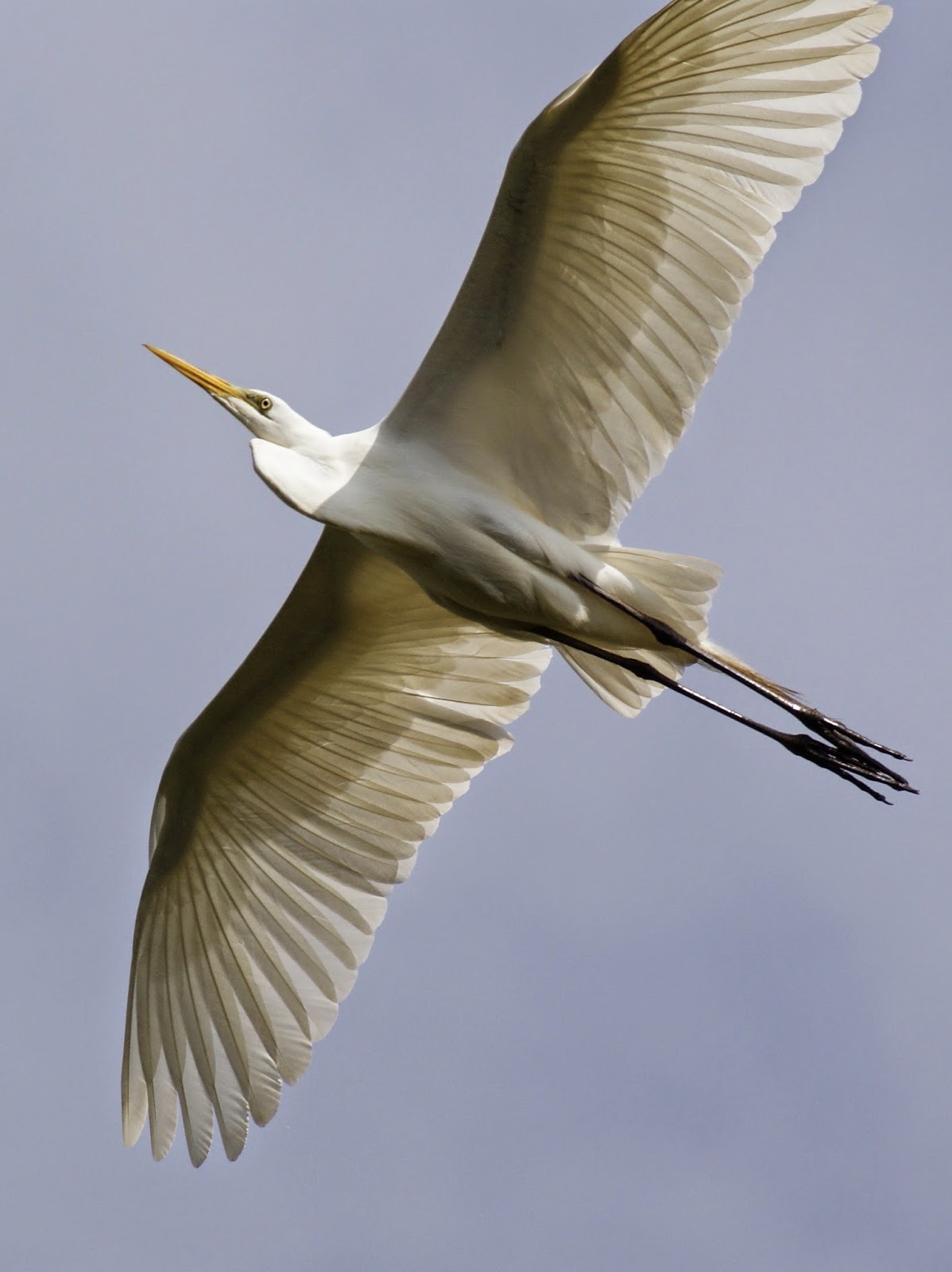
One reason I love visiting the rookery is that it gives wonderful opportunities for photographing Great Egrets, one of my favorite birds. Just stand on one of the observation decks for a few minutes and you are sure to see numerous Great Egrets fly overhead, their white plumage positively glowing against the blue sky.
However, no matter how much you like watching Great Egrets flying, your eyes (and lens) will soon be drawn to the birds on the rookery islands. There are few sights in nature more impressive than a Great Egret in full breeding plumage. It is hard to believe that any female could resist a display like the one below.
Of course, keeping those beautiful feathers in tiptop shape requires a lot of preening.
Most of the Great Egrets had already built their nests, and some birds appeared to have started sitting on eggs.
Others were still busy flying off to collect nesting material.
This bird brought back only a very small twig.
The bird below, by contrast, had brought in a long stick and was proudly passing it over to its mate.
The image that will linger with me from Saturday's visit is of a Great Egret launching itself into the air.
If I had to give this picture a title, I think I'd call it "Jumping for Joy".
.
.
While the most strikingly colored species in the Smith Oaks rookery is the Roseate Spoonbill, the latter are not the most numerous species there. This honor belongs to the Great Egrets. On every visit I have ever paid to the site, Great Egrets outnumbered all other species combined.
The observation decks give great views of the Egrets as they fly to and from their nesting sites.
While normally the most graceful of birds, Great Egrets can look a little ungainly when taking off or landing.
I've noticed that when they return to the nest, they tend to call out to let their partners know they are coming. I suppose this is the Egret equivalent of "Honey, I'm home".
Most of the Egrets hang out in nuclear family groups of two adults plus chicks. However, some appear to cluster in larger groups.
The chicks in this group were the youngest that we saw on this visit.
Whether recently-hatched or a little older, all the chicks spend their time waiting for their parents to come back and then noisily begging for food.
If the parents do not produce food quickly enough, the chicks will get their attention by grabbing their bills.
Of course, Great Egrets are not the only Egrets at High Island. There are plenty of Snowy Egrets also. But I'll leave blogging about these until my next post.
.
Great Egrets are so common in our area that it is almost impossible to visit any significant body of water without seeing one wading in it or fishing from the banks.
Given their size, the bright yellow of their bill and their pure white plumage, they are always strikingly handsome birds.
However, as these photos from Sunday at High Island show, Great Egrets become even more striking in the spring, when they develop their breeding plumage.
At this time of year it is easy to see why they were hunted during the Victorian and Edwardian periods so that their feathers could be used to decorate ladies' hats.
As you may have noticed in the photos above, the addition of long plumes is not the only way that Great Egrets change in appearance during mating season. Their faces also change.
Most of the year, the skin around and in front of the eye is a nondescript color.
In breeding season, the skin changes to a bright green hue.
Handsome as Great Egrets are when they are perched or walking, their real beauty for me lies in the way they fly.
It is true they can look a little awkward when taking off from or landing in the trees at the High Island rookery.
However, when they get into full flight, they are the very epitome of gracefulness.
.