Monday, December 20, 2010

CyFair Campus

.
On Wednesday I took my last walk round the campus before our trip to Big Bend.

The entrance to the nature trail is now graced by a fine wooden footbridge built by a boy scout. 
 
Our N Mockingbirds have already started using the bridge as a perch.

It was fairly quiet for birds, except for the calls of an Eastern Phoebe ...


and the constant chipping of Yellow-rumped Warblers.


Butterflies were largely absent, too. The only one I saw was this very battered Red Admiral.


There was no sign of American Robins or Cedar Waxwings, both of which are normally present on the campus in large numbers by this time of year. They may just have started migrating late. Or they may have arrived, taken one look at all the changes made to the campus this year and decided to look for a new site.

Just as I was leaving to go back to my office, I was thrilled to see a Red-tailed Hawk circle overhead. Our resident pair did not appear at all during the summer but perhaps they have decided to set up home on the campus again. I hope so.


.

Saturday, December 18, 2010

A Bird Bully

.
A few days ago I mentioned that we have a very territorial Yellow-rumped Warbler in our front yard. Since it flew in from the north, it has been chasing away all other Yellow-rumps that try to reach our feeders. It has been driving off our Ruby-crowned Kinglet and Orange-crowned Warblers, too.

Our Yellow-rumped Warbler stading guard


Well, this bird is now trying to extend its control over the yard by chasing off more bird species. The other day I watched as it swooped in on the feeders and drove away Carolina Chickadees and American Goldfinches. Then I was amazed to see it giving the same treatment to a couple of House Sparrows, usually one of the toughest and most aggressive of bird species.


And the warbler isn't just protecting the feeders. It has even started chasing other birds away from the birdbath.

Of course, other birds do still manage to feed and drink in the yard. Sometimes there are just so many birds around that the Yellow-rumped can't get rid of all of them. And even this very determined little bird can't intimidate our resident Downy and Red-bellied Woodpeckers, or our Northern Mockingbird, or our nine resident House Finches. Or maybe it's safer to say that it hasn't managed to intimidate them yet!

P.S.
This warbler reminds us of a very territorial female Anna's Hummingbird that took over our deck in Pittsburg, California some years ago. For about 8 weeks we watched in awe as she battled tirelessly from dawn to dusk to keep all other hummers away from two hummingbird feeders. It was a truly herculean task because there were often a dozen or more other birds trying to drink at one time. However, she was incredibly successful and it was only very rarely that any of the other hummers managed to sneak in and get a quick drink.
.   

Thursday, December 16, 2010

Away Again

.
By the time you read this, Dee and I will be on our way to Big Bend National Park. Last time we went there, we flew to Midland-Odessa but this time we're going to drive all the way. As neither of us likes long days in the car, we'll be breaking the journey, staying a night in Del Rio on the way out and a night in Uvalde on the way home.


Breaking the outward journey will give us a little time to do some birding at Marathon, where we saw a lot of good birds on our last trip to Big Bend. The stop at Uvalde will let us take another look at Cook's Slough, which we visited last month. We'll probably visit Mitchell Lake in San Antonio on the drive home, too.
 
We both fell in love with Big Bend on our last trip there. The scenery was stunning and we saw a lot of great birds, as well as Javelinas and Deer. (You can see more photos by clicking on 2008 in my blog archive.) 


We'll only have three nights in the park, which isn't much for such a huge area, but I'm sure we'll see a lot this time, too.

I won't be able to blog while we're in the park, because there is no phone or Internet service there. But I've prepared a couple of blogs to appear here while we're away.
.

Wednesday, December 15, 2010

Tuesday, December 14, 2010

Sunday Morning

.
Early on Sunday I drove down to Cullinan Park. Unfortunately, there were very few birds around - except for ducks - and it was bitterly cold.So after 20 minutes I gave up and drove back up Highway 6 to Bear Creek Park, where I bumped into Jim Hinson again.

We spent a couple of hours birding together, looking for Dark-eyed Juncos. We didn't have any luck with these but there were plenty of other birds around, including four Pine Siskins in one tree at the same time.

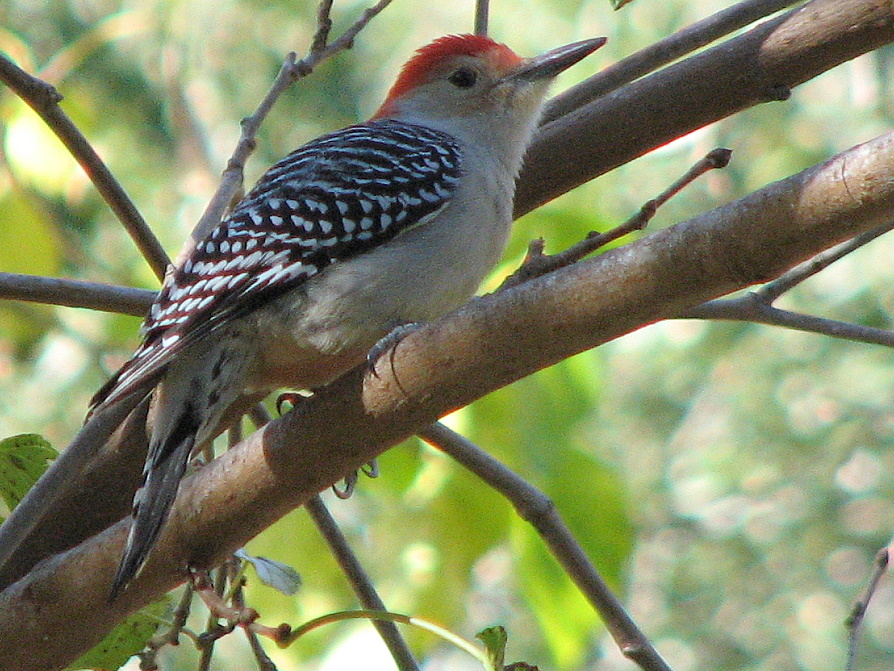
There were several woodpeckers, too, including a Northern Flicker.


As seems to be normal this year, there were Eastern Phoebes everywhere.


At 11:00, I left Jim and headed home, taking one final swing along Fox Road as I went. It was there that I came across a Red-tailed Hawk perched among the trees. I love Red-taileds and so I just had to stop to admire the bird. She seemed to be feeling the cold as much as I was, because she had one foot tucked up into her beast feathers. Perhaps because of the cold, she stayed where she was and let me take a series of photos.


.

Monday, December 13, 2010

End of the Week

.
Last week ended with only one first-of-season sighting at CyFair when I came across an American Pipit grazing just outside the Library.


Before the soccer fields were turned into parking areas, we used to regularly get flocks of 20 or so Pipits. I suspect we won't be seeing flocks that that again this winter.

Back at home our feeders continued to attract a range of birds, from Northern Mockingbird and White-winged Doves to Orange-crowned Warbler and Ruby-crowned Kinglet. As usual, the latter is proving to be difficult to photograph.


A Yellow-rumped Warbler has taken up residence in our elm and is fiercely territorial, chasing away any other Yellow-rumped that appears. It chases off our Orange-crowned Warbler(s), too.


We have American Goldfinch but only a few so far. No doubt more will turn up as the winter sets in and other food supplies become scarcer.


Our resident pair of Downy Woodpeckers comes regularly to the suet feeders. They are among the least shy of all our birds.


As usual, though, the most numerous species is the House Finch. There were nine of them on our feeders yesterday.

.

Saturday, December 11, 2010

Bear Creek Park

.
I took a couple of hours off work to do a little birding in Bear Creek Park.

It was one of those glorious Texas winter mornings.


The trees along Sullin's Way were packed with birds: American Goldfinch, Carolina Chickadees, Yellow-rumped Warblers, Orange-crowned Warblers, Chipping Sparrows, Yellow-bellied Sapsucker, Red-bellied Woodpeckers, Downy Woodpeckers, Northern Flicker. 

A Red-shouldered Hawk taking the morning sun was the only bird I managed to ge a recognizable photo of.


I bumped into Jim Hinson, who was looking for Towhees. We scanned the area for Pine Siskins and Dark-eyed Juncos but we didn't spot any. 

Jim suggested that we go and visit at another good site that he knew. So off we drove.

We hadn't been at the other site long when we spotted a Song Sparrow followed by a Fox Sparrow, a new bird for my year list. Then a Gray Catbird popped up.

Further down the trail, we walked across a field that Jim said was good for Le Conte's Sparrows. An American Kestrel watched us from a tree top.

We flushed two small birds. Probably Le Conte's but they had disappeared again before I could be sure of the ID.

We walked on. Another small bird flew up. This one perched in a bush nearby, giving me time for a good look. Yes, a Le Conte's! Another bird for my 2010 list.

Unfortunately, my time was up and so I thanked and said goodbye to Jim. I'll go back to this site soon, though, because Jim says it's an excellent place for seeing American Woodcock at sunset.
.

Thursday, December 09, 2010

CyFair Again

.
Over the past 6 years, several of us who work at LSC-CyFair have been recording the different bird species that we see on the campus. Our list has now grown to 157 species. On Monday, I and a couple of colleagues were discussing the chances of our seeing new species in the future, given how much construction work and habitat destruction has been going on here this year. My view was that we would be lucky to add any birds to the current list, except perhaps for some unusual flyovers.

Today was a busy work day and so I didn't have time for birdwatching. However, as I was walking from my office to another campus building, I noticed two birds pop up on top of a small tree. Our first ever House Finches! I grabbed a quick photo and then emailed my colleagues to tell them our list has now grown to 158 species.

 Male House Finch

P.S.
House Finches been common on the east and west coasts for years and have been gradually expanding their range inland. Just 5 or 6 years ago, they were rarely spotted in southeast Texas but now they are turning up in our area in significant numbers. It's certainly an unusual day at our home in Cypress if there aren't at least a few House Finches on the feeders. 
.


Wednesday, December 08, 2010

Tuesday, December 07, 2010

Birding the LSC-CyFair Campus

.
I got to work early yesterday so that I could do a birding walk around the campus. It was worth the effort!

The nature trail area produced most of the normal birds, including several White-winged Doves that, unusually, did not fly away at my approach.

 White-winged Dove

Yellow-rumped Warblers, Orange-crowned Warblers, American Goldfinch and Ruby-crowned Kinglets were busy in the trees, as were Northern Cardinals, Carolina Chickadees, Blue Jays and Northern Mockingbirds. The bird I really wanted to get a good look at was the Hermit Thrush which arrived a few days ago.I got glimpses of it as it scuttled around through the undergrowth. Then suddenly it popped up on a branch and stayed there long enough for me to get a photo. A lovely little bird!

Hermit Thrush

The northern retention pond had our usual three large waders: Great Blue Heron, Great Egret and Snowy Egret.

 Snowy Egret

It also had lots of Eastern Meadowlarks, Killdeer, Mourning Doves and Savannah Sparrows.

 Savannah Sparrow

At first I thought the southern pond was empty of birds. But then I noticed a small group on the water. Two Canvasbacks were sailing about with several Lesser Scaup, while a Ring-necked Duck was bringing up the rear.


These are the first winter ducks that I've seen on the campus this season. Hopefully more will be joining them in the coming months.

All in all, I saw 27 species in an hour. That's about as good a total as I ever see in a day at work.
.

Monday, December 06, 2010

Cullinan Park Again

.
As Dee had never been to Cullinan Park in Sugarland, I drove her down there yesterday. The weather was very different from how it had been a week earlier. This time it was horribly cold, cloudy and windy.

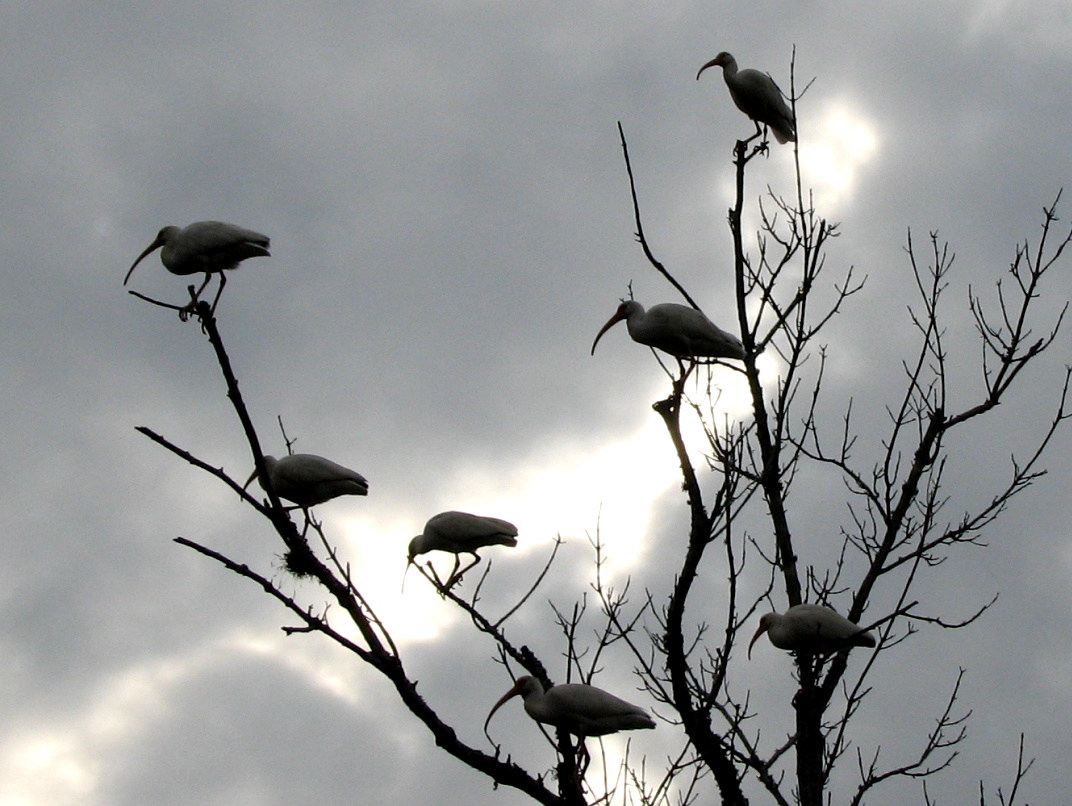
The lake had much the same water birds as last week, except that this time some Ruddy Ducks were in evidence. The only birds in the trees around the lake were dozens of White Ibis.


We spent a couple of hours birding the undergrowth and trees along the road. All we managed were glimpses of common birds: Northern Cardinals, Blue Jays, Carolina Chickadees, American Crows, Red-bellied and Downy Woodpeckers, Orange-crowned Warblers, Yellow-rumped Warblers, Ruby-crowned Kinglets, American Goldfinch and Eastern Phoebes - lots of Eastern Phoebes.

As we left the park, we stopped so I could grab a photo of a pair of Red-tailed Hawks perched on utility wires opposite the park entrance. Not a great photo but it shows pretty clearly the difference in size between the female and (smaller) male and the difference between front and back plumage.

.

Sunday, December 05, 2010

Competition for the Birds

.
We've always had a lot of Fox Squirrels in our yards and they've always spent a lot of time trying to get seed from our bird feeders. Sometimes they've succeeded, sometimes they've failed, and sometimes they've wrecked feeders in the process. Over the past year or two, though, our yards have been taken over by the smaller Gray Squirrels. These generally leave the feeders alone but they are quick to find and devour any other food they can find in the yards.


I smear peanut butter on fences and trellises for the birds and this has always attracted lots of species, from Northern Mockingbirds to Yellow-rumped Warblers. Unfortunately, any peanut butter I put out these days is usually gobbled up by Gray Squirrels before any birds have a chance to reach it. Oh, well, I suppose squirrels need to eat, too.


And they can even be quite decorative at times. 


Yesterday I was sitting at our livingroom window hoping to get a photo of our Ruby-crowned Kinglet. I noticed a movement in the wisteria that grows up our garden shed. Here comes the Kinglet. But no. It was a large rat.


This rat (or maybe there are several) lives in the brush pile I've created beside our shed and it somehow survives in spite of the hours that one of our cats and a neighbor's cat spend trying to catch it. While not as pretty as our birds or even as our squirrels, it has a certain charm of its own.

.

Friday, December 03, 2010

Bits and Bobs

.
Our yards at home have been pretty busy. All of our normal winter residents have arrived now but only in small numbers. The ones who have arrived aren't yet visiting the feeders as often as I hope they will later, when other food becomes harder to find. We've only seen our male Ruby-crowned Kinglet a couple of times and even our one Yellow-bellied Sapsucker only pops in occasionally.


It's been fairly quiet on the college campus, too. Yellow-rumped Warblers are the most common birds visible at present - except for our innumerable N Mockingbirds, of course. I still hear wrens everywhere but haven't seen any recently. A Brown Thrasher has been around for some weeks and yesterday he was hanging out with Cardinals. I've been pleased to hear Carolina Chickadees, because I hadn't seen or heard any on the campus for months.

At lunchtime I was surprised to see two Ring-billed Gulls hanging out in one of the parking lots. We usually only see gulls here when there are storms on the coast, so I'm not sure what caused these two birds to pay us a visit.


P.S. 
Did some quick birding around the campus nature trail this morning and turned up some new (this season) birds: Hermit Thrush, White-throated Sparrow, Chipping Sparrow and Savannah Sparrows. 

.

Wednesday, December 01, 2010