.
Leaving the dike, we drove along the top of the levee to reach Texas City Bay Park. The strip of water between the levee and park was busy with wading birds: Great Blue Heron, Great Egret, White Ibis and Roseate Spoonbills.
Just before reaching the park, we passed a Belted Kingfisher and then disturbed a Red-tailed Hawk.
We picnicked on a bench, surrounded by huge totem poles (carved by Boy Scouts) and looking over the lagoon that runs along one edge of the park.
One of the trees nearby had a fine Red-shouldered Hawk.
Other trees had Loggerhead Shrike, Eastern Phoebe and a pair of Eurasian Collared Doves.
Most of the birds, however, were in and around the lagoon.
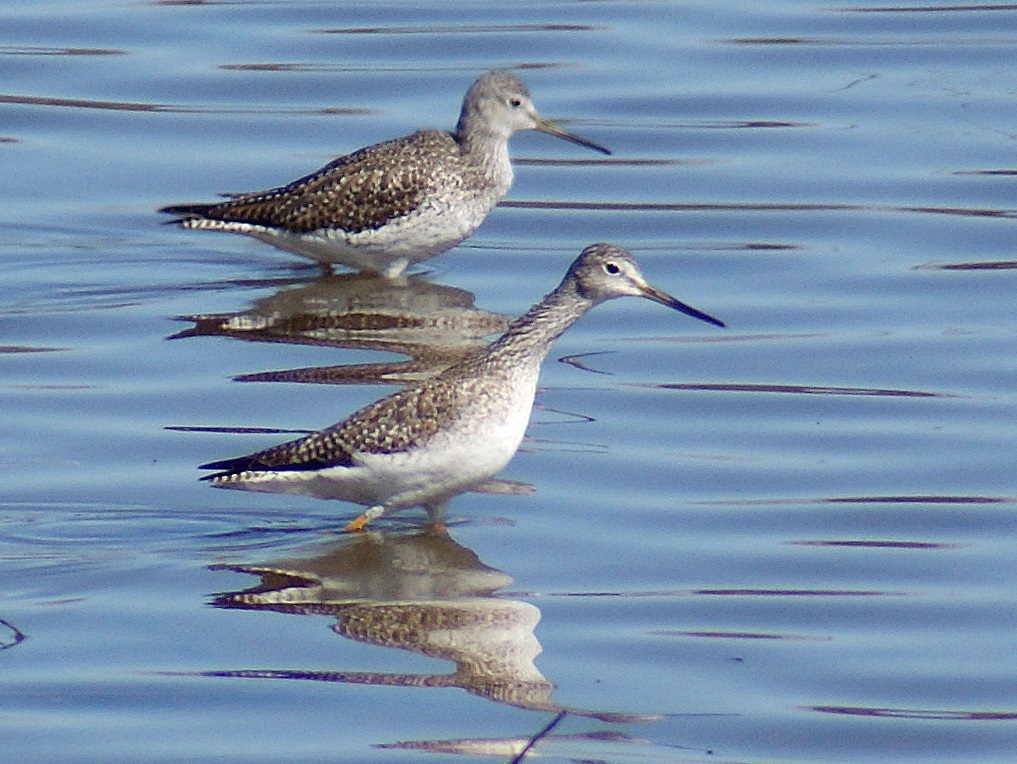
The water's edge had Savannah Sparrows as well as Greater and Lesser Yellowlegs.
Yellowlegs
A Spotted Sandpiper flew off as I approached but a Snowy Egret was less skittish.
The most common birds on the lagoon were American Coots, Northern Shovelers, Mallards, Pied-billed Grebes, Gadwalls and Lesser Scaup.
Northern Shoveler
There were also other types of duck present. Although I didn't have a scope with me, I was able to pick out Ruddy Ducks, American Wigeons, Blue-winged Teal and Green-winged Teal.
Green-winged Teal
When I totaled the birds that we had seen along the dike and in the park, I was surprised to find that we'd seen 45 species in less than two hours. So apart from the area being much more attractive than we had expected, it was also very productive for birding. We'll certainly be heading down there again before too long.
.
.
Dee and decided to take advantage of the good weather to drive over to a site we've never visited before, the Texas City Dike. It would also be a good opportunity to try out my new zoom lens.
When we arrived in Texas City, we were pleasantly surprised to find that the area was not the mass of oil refineries and other industrial buildings that we were expecting. In fact the road to the dike went through some attractive farmland. The view at the dike itself was also much better than we expected, although part of the shoreline was taken up with refinery buildings.
Both sides of the 5 mile-long dike had Double-crested Cormorants, Forster's Terns and three types of Gulls: Laughing, Ring-billed and Herring.
There were also plenty of both Brown and White Pelicans, always fun to watch.
The right hand side had the first Buffleheads and Common Goldeneyes that we've seen for a while.
Buffleheads
It also had half-a-dozen Common Loons.
The only songbird we noticed was a solitary Savannah Sparrow, seeming oddly out-of-place two miles from the shore.
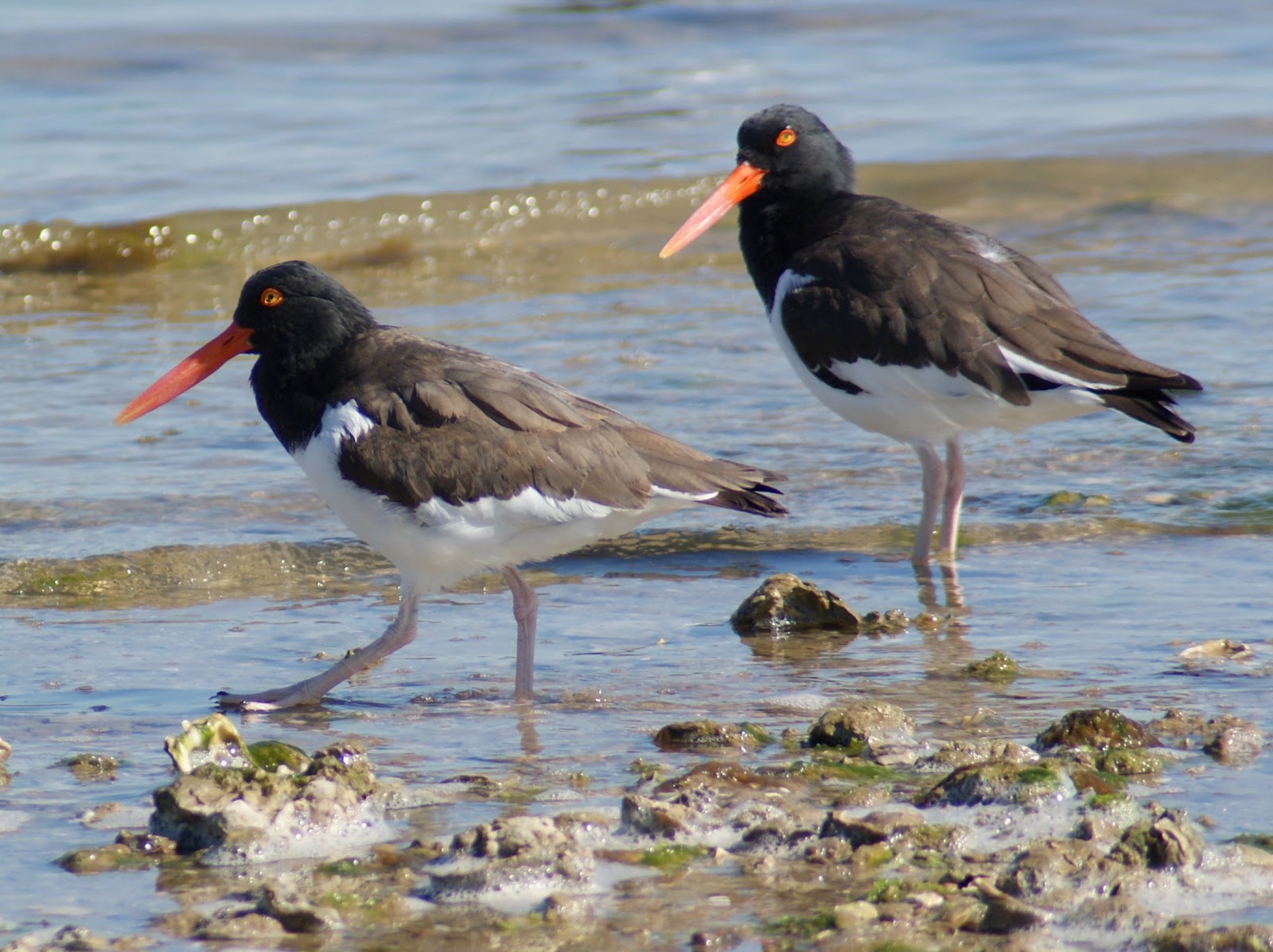
Just before the end of our visit, we pulled into a parking area to watch a Snowy Egret and a Great Blue Heron and wound up watching a pair of American Oystercatchers instead.
There was a coldish wind blowing across the water, so we decided to drive along the levee to have our picnic lunch in the Texas City Bay Park, only a little north of the dike entrance. As you'll see from my next post, the park was certainly worth visiting.
.
.
Yesterday dawned dry and clear for a change. As if to celebrate the return of good weather, a Bald Eagle flew over as I was on my way to work. That was species #122 on my year list.
At the college, the nature trail area was too muddy to allow me to get close to most of the birds that were around. A flock of Cedar Waxwings stayed out of camera distance, as did the Pine Warblers which have been appearing in good numbers for the past few days. Only one of the many Yellow-rumped Warblers came close enough for a photo, showing the yellow that decorates both its rump and the breast just below the wings.

.
Of all the birds that regularly use our feeders, none are more welcome than House Finches. Dee and I loved them when they used to come to our deck in California. And we love them now that they visit our yards in Texas.
However, there haven't always been House Finches in Texas. The species was originally limited in range to Mexico and the southwestern USA. Then, in the 1940s, people started to sell captive House Finches in New York City, where the birds were renamed "Hollywood Finches" in order to boost sales. When people realized that such trading in native birds was illegal, they started releasing the captive birds into the wild. And the finches bred and spread until they have now colonized the whole of the USA and even parts of Canada.
One reason why the House Finch (Carpodacus mexicanus) has been so successful is that it is one of the few birds that is aggressive enough to defend itself and its nesting sites from the invasive House Sparrow.
Female House Finches have brown backs and streaked fronts.
By contrast, most adult males have bright red on heads, necks and shoulders.
However, not all adult males are red. Depending on their diet, some males may be different colors. In California we often saw orange variants. Here in Texas, the variants we see are usually yellow or gold.
Other Finches
There are two other species in the genus Carpodacus but one of them - Cassin's Finch (Carpodacus cassinii) - never visits southeast Texas. The other species is the Purple Finch (Carpodacus purpureus), which often visits our area in the winter. If you want to see Purple Finches, you should head down to Bear Creek Park in Houston, because several males and females have been living in the park for the past couple of months. The best place to look is at the junction of Sullins Way and Brandt.
.
.
I only managed a couple of short walks along the nature trail this week.
The Cedar Waxwings and American Robins that were present in large numbers seemed to have disappeared by week's end, leaving the larger trees to our resident Northern Mockingbirds and White-winged Doves.
Yellow-rumped Warblers and Ruby-crowned Kinglets were still present but they had been joined by lots of Pine Warblers.
We used to get large flocks of Savannah Sparrows, with the occasional Field Sparrow tagging along. However, since the soccer fields were turned into parking lots, I have seen only a few Savannahs and no Field Sparrows.
Savannah Sparrow
So I was delighted on Thursday to run across a flock of half-a-dozen Field Sparrows.
Thursday also produced a flyover by a Crested Caracara, always a beautiful sight.
Behind the college, the same day was notable for the presence of a huge flock of Red-winged Blackbirds.
When I looked more closely, I realized that the flock included a large number of Brown-headed Cowbirds.
Nearby, dozens of Mourning Doves were clustered in the trees and on the utility lines.
Now that another cold front is pushing through our area, I'm hoping that we'll get an influx of new visitors when I get back to the campus on Monday.
.
.
Prairie dogs are little rodents that dig burrows and live together in towns. I see lots of them whenever I go to Denver and I've always thought they were very cute. However, it wasn't until I heard a radio story about them yesterday that I realized they are also very smart.
The story started out by explaining that prairie dogs vocalize a lot and warn each other when some danger is approaching. Okay, that's not surprising. Then the scientists featured in the story explained that they had analyzed the dogs' calls and learned that the dogs made different calls when they encountered a human, a dog or a coyote. That's interesting but again not very startling.
The next part of the story was what made me change my opinion. The researchers dressed several people in similar clothes except for differently colored shirts - and the prairie dogs made different calls depending on which person approached them. That's impressive!
What came next was even more impressive. The researchers went into more depth with analyzing the animals' vocalizations and they found that the latter varied according not just to the humans' shirt colors but also to the size of the people wearing the shirts. So the dogs were in effect saying things like, "Look out. Here comes a tall person with a red shirt" or "Uh-oh, here comes a short person in a green short".
So next time I see some prairie dogs, I'll certainly look at them with more respect. Meanwhile they'll be saying to each other, "Careful. Here comes a tall bald human in a purple shirt".
.
.
Sunday morning we were out of the motel by 8:15 and heading west along Stewart Road on our way to Lafitte's Cove. Unfortunately, the weather was miserable - cold, dark and wet. This didn't seem to worry the birds but it probably meant we were going to bird mainly from the car - and that I wouldn't be able to get many photos.
We arrived at Sportsman's Road to see our first American Oystercatcher of the year. Then the marsh along the roadside had a mixed group of Great and Snowy Egrets, Roseate Spoonbills, Tricolored Herons and White Ibis.
On the opposite side of the road, a Killdeer and a Wilson's Snipe were wandering around together.
The rain was really quite heavy when we reached the end of the road but we still had reasonable views of a Black-bellied Plover and a Clapper Rail.
As Dee had been talking about Sandhill Cranes, I had promised her I would find some. So we turned up Settegast Road, passed the Belted Kingfisher who hangs out there, and drew up beside a pair of Sandhills. The rain didn't let up but we enjoyed watching the pair graze.
Arriving at Lafitte's Cove, we were confronted with several Egrets and Spoonbills, as well as some Blue-winged Teal and Northern Shovelers. We tried walking the trail but soon gave up because of the rain.
Well, the day certainly wasn't turning out the way we had hoped and there were still several species that we hadn't seen, notably Reddish Egret and Black Skimmer. However, the weather was clearly going to limit us to sites that we could bird from the car.
I decided we should head to Big Reef, at the east end of the island. We'd visited the site once before but have not stayed because it was so crowded with beachgoers.
As it turned out, it was a good decision: There were no other visitors and we were able to park right at the water's edge, only a few yards from a group of perhaps 200-300 Black Skimmers, standing on sandbanks with the odd gull and tern mixed in with them. A few minutes later, the sky ahead was absolutely filled with large birds heading towards the Skimmers' sandbanks. They were more Skimmers, probably 500-600 of them.
The beach also had several Brown Pelicans, some Sanderlings, a Ruddy Turnstone and a couple more Black-bellied Plovers.
Black-bellied Plover
Best of all, we finally saw a Reddish Egret and got to watch it running about after fish.
It was now getting near the time when we had to head home. However, as Common Loons had been reported near the bridge on 61st Street, we took that route out of town. We pulled into the rough parking area below the bridge. And there in front of us, visible through the rain, were two Common Loons, which were soon joined by a third.
Our trip hadn't worked out quite as we had expected but we'd both enjoyed it in spite of the weather on Sunday. We'd started off with a life bird (Prairie Warbler), had ended with a species we rarely see (Common Loon) and had seen quite a few other species in between. Our weekend list was 60 species, of which 25 were new for the year.
.
.
One of the things that makes birding exciting is that you can never be sure what bird is going to turn up where. This was brought home to us ten days ago when Dee and I saw a White-breasted Nuthatch in Spring Creek Park in Tomball.
The element of chance came into play again yesterday when we were in Spring Creek Park again, this time on a very dark and damp morning. We were parked next to the area where we had seen the White-breasted Nuthatch about 10 days before and we were about to leave after I had done some unsuccessful searching for Brown-headed Nuthatches. A truck pulled in and parked next to us and a man got out and walked across the road to the trees. As he was carrying binoculars, I walked over to him to ask if he was looking for the White-breasted Nuthatch. He was. I told him where we had seen it and he walked over to the area.
A few minutes later, I was standing by our car when I heard a Nuthatch. Right on cue, Dee said, "There it is. Right in front of you." Sure enough, the White-breasted was walking up a tree trunk not 20 feet in front of our car and the other birder's truck.
I grabbed a quick photo and turned around to alert our fellow birder. He had disappeared! We jumped into the car and drove around the loop looking for him. As he was nowhere in sight, I walked down the nearest trail and soon found him.
I told him that we'd just seen the Nuthatch and we both laughed about the arbitrariness involved in birding. He joked that he might just go back and sit in his truck and wait for the Nuthatch to perch on his hood.
I wonder if he managed to see the bird.
.