.
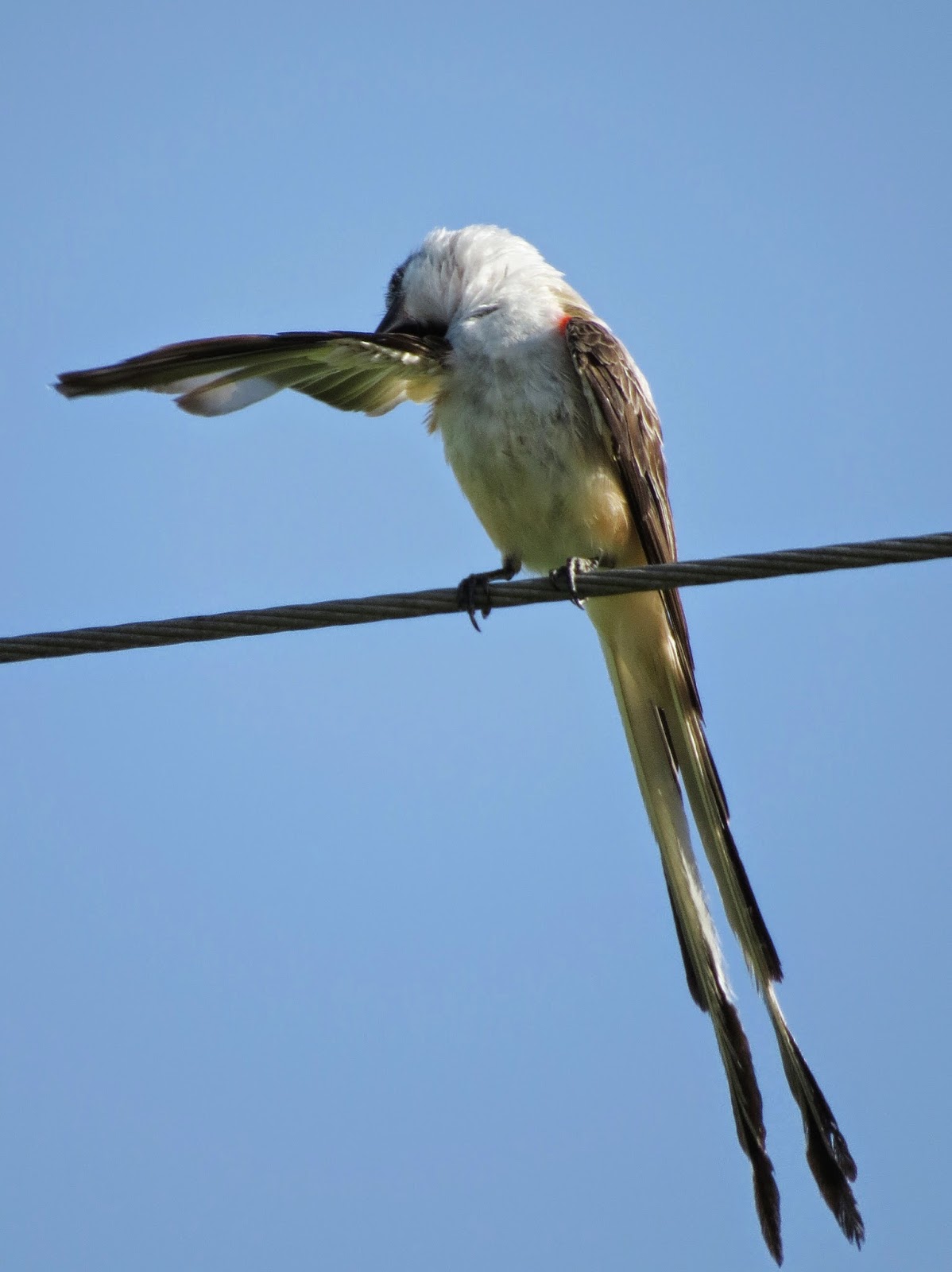
If you drive along country roads anywhere in our area at present, you are virtually guaranteed to see Scissor-tailed Flycatchers. During the summer they hang out in very considerable numbers on roadside utility wires.
The males are stunningly beautiful, with spectacular tails. (The females' tails average about 30% shorter.)
Juvenile birds lack the long tail and have a yellowish wash on their belly. They look rather like Western Kingbirds.
Some individuals are skittish and will fly off as soon as you stop near them. Others will ignore you, allowing you to watch as they do their preening. It's something that I never tire of watching.
.
.
The Katy Prairie isn't as busy with birds at this time of year as it is, for example, in winter but even a short drive will usually turn up a nice selection of species.
You're sure to see lots of Northern Mockingbirds, and many of them will be juveniles.
You'll certainly see Mourning Doves also.
Eurasian Collared Doves are an increasingly common sight. Although an invasive species, they don't seem to be adversely affecting our native birds, or at least not yet.
Where this water you are almost certain to see Great Egrets and you may also see Black-necked Stilts (below).
Many open grassy areas will have Killdeer but you may also see Common Nighthawks (below) sitting in the grass, soaring overhead or perching in nearby trees.
Where there is roadkill, you are more or less guaranteed to see Black Vultures.
Utility poles are a good place to look for Crested Caracaras.
Utility wires may be providing perches for Tree Swallows.
However, even more common on utility wires are Scissor-tailed Flycatchers. But let me look at them in my next post.
.
.
As you might expect, herons weren't the only birds we saw at Baytown Nature Center.
Great Egrets were common, either perching in trees or hunting in the shallows.
We watched as this one preened.
There were more Snowy Egrets than I'd ever seen on previous visits.
You just have to love those yellow feet.
The posts in Burnett Bay were hosting Laughing Gulls and Brown Pelicans. Many of the Pelicans were preening.
A solitary Gull-billed Tern was fishing too far away for photos but a score of Least Terns were occupying a flooded area next to the road. There yellow bills and white foreheads make them easy to identify.
The group included several juveniles.
Three Killdeer were sharing the same area with the terns. I'm always truck by what beautiful eyes they have.
Our first Clapper Rail of the year crossed the road just ahead of us and hunkered down out of sight in the reeds. Nearby a Scissor-tailed Flycatcher watched from a tree branch. I've seen a lot of Scissor-tailed Flycatchers since we moved to Texas but I don't think I've ever seen one with a longer tail. Not a bad bird to end our visit with.
.
.
As you may have noticed, I haven't been posting so often lately. This isn't because I'm losing my interest in birds but simply because I've been too busy with family and work to get out and bird. So I was delighted when Dee and I finally managed to squeeze in a morning of birding on Saturday.
After a quick visit to see the Swallow-tailed and Mississippi Kites that hang out around Aweigh Drive in Crosby, we headed over to spend an hour at the Baytown Nature Center. I was hoping to see a Black-crowned Night Heron, the only Heron species I haven't yet seen this year.
Our first Herons turned up by the roadside in Baytown before we even reached the Nature Center. First up was an adult Yellow-crowned Night Heron.
A few yards away we saw a handsome juvenile, presumably the offspring of the adult.
We continued to the Nature Center, where a Tricolored Heron was hunting in a ditch just before the first pond. Judging by the rusty color of its plumage, this was a juvenile bird. (We later had flyovers by two adult Tricoloreds.)
Nearby was an adult Yellow-crowned Night Heron.
Fifty yards further on, a Great Blue Heron was prowling about in a flooded area next to the road.
We stopped by the butterfly garden after noticing a Little Blue Heron perched on a pole beside the road. That was Heron species number four.
Heron species number five turned up in the form of a Green Heron that flew over the road and seemed to land somewhere near the start of the Chickadee Trail. I walked the first few yards of the trail and, sure enough, there was the Green Heron.
As time was limited and the mosquitoes were unbelievably fierce (even for Baytown), we decided not to walk the loop trail, Instead we spent half-an-hour birding from the car. We spotted several more Yellow-crowned Night Herons and some other interesting birds but, alas, no Black-crowned Night Herons.
I was a little disappointed but not too much so. After all, it isn't every day that I see five of our six Heron species - and I'm sure a Black-crowned will turn up when I can fit in some serious birding.
.
.
If you want to see plenty of action at the Smith Oaks rookery in High Island, you should go soon. There are still plenty of birds to watch but the chicks are growing up fast.
In my previous posts I focused on the Roseate Spoonbills and Great Egrets. However, there are plenty of other birds around the pond that contains the rookery.
I didn't see any Anhingas but Neotropic Cormorants were very numerous.
A few of Tricolored Herons were nesting but I couldn't get any worthwhile photos, so I had to settle for this shot of a White Ibis instead.
Here and there among the many Great Egrets were the much smaller Snowy Egrets. Groups of young birds were waiting for their parents to return with food.
As soon as a parent returns, the chicks follow it around, begging for a meal.
If parents don't oblige quickly enough, the chicks have ways of encouraging them to cooperate.
No wonder that several of the adults sometimes fly to a different part of the rookery just to get a few moments of peace!
.
.
Quite a few young birds appeared in our yards in May, notably a House Finch, a couple of Carolina Wrens and several Northern Cardinals (below).
However, June is the month when the offspring of most of our resident birds appear.
We seem to have so many new Blue Jays that we can't keep count. Some of them are still looking scruffy but some are already sporting nice crests.
We have rather more young White-winged Doves and House Sparrows (below) than we would wish for.
Luckily, our latest young male Red-bellied Woodpecker soon moves the doves and sparrows away from the feeders.
He has an extraordinarily long tongue!
Less dominant is a young Downy Woodpecker, which turns up regularly.
The new arrival that we're most excited about, though, is a Tufted Titmouse. It's the very first time that Titmice have bred in our yards.
The youngster has been coming to our feeders for a couple of weeks. Like most young birds, its beak is edged with yellow.
The other day it seemed to feel that the heat was just too much to bear.
(In reality, it was probably sunbathing either to get more Vitamin D or to get rid of parasites.)
.